

If you're calculating how much it costs to hire a Sinaloan banda, start with $6,300 MXN per hour or $4,562 MXN for a serenata (serenade), and consider that a banda with 12 to 16 musicians can cost between $15,000 and $60,000 MXN per event. The final price mainly depends on the duration, the size of the group, travel, and the equipment included.
You're organizing a wedding, a quinceañera (15th birthday celebration), or a national holiday party, and you need a figure to see if the banda fits your budget. The problem is that an hourly quote doesn't directly compare to a package for the entire night. It's also not the same cost to bring a full banda to a nearby community as it is to hire a performance with audio, lighting, and travel outside the city.
The clearest way to understand it is to think of a formula:
Final Price = musicians + show hours + travel and expenses + equipment + event conditions.
The key idea: an hourly rate is useful for brief services, while an event price combines duration, logistics, and production into one package.
In this guide, you'll find verifiable references, a table to compare options, and budget examples for different types of celebrations. You'll also see what to ask before accepting a quote, how to identify costs that don't appear in the first message, and how to negotiate without turning the conversation into an awkward haggle.
Index
- Introduction How Much Does It Cost to Hire a Sinaloan Banda Today
- What is a Sinaloan Banda and Why is Its Price Different
- Factors Determining the Final Price of Your Hire
- Real Price Ranges by Type of Service and Duration
- Budget Examples for Wedding, Private Party, and National Holiday Event
- How to Negotiate and Hire Without Overpaying
- Conclusion Find Your Ideal Sinaloan Banda at Mariiachi.com
Introduction How Much Does It Cost to Hire a Sinaloan Banda Today
The quote comes with a brief figure: “the banda charges this much.” To know if it really fits your budget, break that number into four parts: musicians, performance hours, travel, and equipment. An hour of serenata and a night of music function as different services, even though both are described as “hiring a banda.”
In Sinaloa, a documented reference for national holiday events handled $6,300 MXN per hour, $4,562 MXN for a serenata, and $360 MXN per extra song. The official document on costs for mariachis, norteños, and bandas helps understand this pricing scheme. The rate may serve for a specific intervention, but it doesn't represent the cost of a complete celebration by itself.
For a group of 12 to 16 musicians, a published reference for 2026 places the price between $15,000 and $60,000 MXN per event. At a wedding, a block of 2 to 4 hours can range from $18,000 to $60,000 MXN, according to the price reference for norteño and Sinaloan bandas in 2026.
The difference between both references has a practical explanation. A serenata may include a brief entrance and a limited repertoire. A wedding may require more execution time, several breaks, travel, setup, sound, and coordination with the program. It's like comparing the cost of delivering a dish to that of catering an entire banquet: they share elements, but the operation changes.
The Number Doesn't Tell the Whole Story
Each musician adds fees. Each additional hour increases work time. If the location is outside the city, travel and expenses appear; if sound isn't included, you must also consider the necessary equipment to ensure the brass and percussion are heard correctly.
Therefore, a useful quote should answer five questions: who plays, how long, where, with what equipment, and under what conditions. Also, ask what happens if you request extra songs or if the event is delayed. A low figure can change when those details are pending.
How to Use These References
Use the hourly rate to welcome guests, accompany a meal, or enliven a national holiday act. Use the event range for a wedding or private party with a broader musical block. Comparing proposals only works when they include the same hours, number of musicians, travel, and equipment.
The goal is to identify what you're buying before booking the date.
What is a Sinaloan Banda and Why is Its Price Different
A Sinaloan banda functions like a compact orchestra of brass and percussion, not like a small group for background music. Its sound combines trumpets, trombones, clarinets, tambora, tuba, and other instruments that sustain the melody, rhythm, and power of the ensemble. Therefore, its price reflects a complete operation, not just the time each song lasts.
The full lineup is usually managed with 12 to 16 musicians, depending on the contracted format. Each member represents a part of the budget. Unlike a recording, everyone must travel, set up, play, and leave the location. This chain of work explains why a home performance and a show in a large hall can have different costs.
The Size of the Ensemble Changes the Operation
The tambora and tuba need more space than a guitar. The brass requires an orderly distribution, the musicians need to move, and the group must be located where the sound reaches clearly, without bouncing uncomfortably. Entries, breaks, repertoire, and volume must also be coordinated.
More musicians mean more fees, more transportation, more coordination, and, in certain spaces, more audio needs. A reduced ensemble may work for an intimate gathering. A full formation has greater sound presence and can better sustain a large dance floor or a crowded party.
It's advisable to distinguish between a traditional Sinaloan banda, a technobanda, and a reduced banda. They may share repertoire or aesthetics, but they don't necessarily have the same number of performers or require the same logistics. To clarify the difference before requesting a quote, check out this guide on the difference between banda and norteño.
What You Should Confirm When Asking for a Price
“Sinaloan banda” doesn't always describe a unique format. Ask how many musicians will attend, what instruments are included in the lineup, and if the group will play entirely live. Also confirm if the price includes travel, setup, and sound equipment.
Request a sample of the repertoire and recent videos. A performance with few musicians can work very well in an intimate space, while a full banda usually fits better when you're looking for a wide sound and a high-energy party.
Factors Determining the Final Price of Your Hire
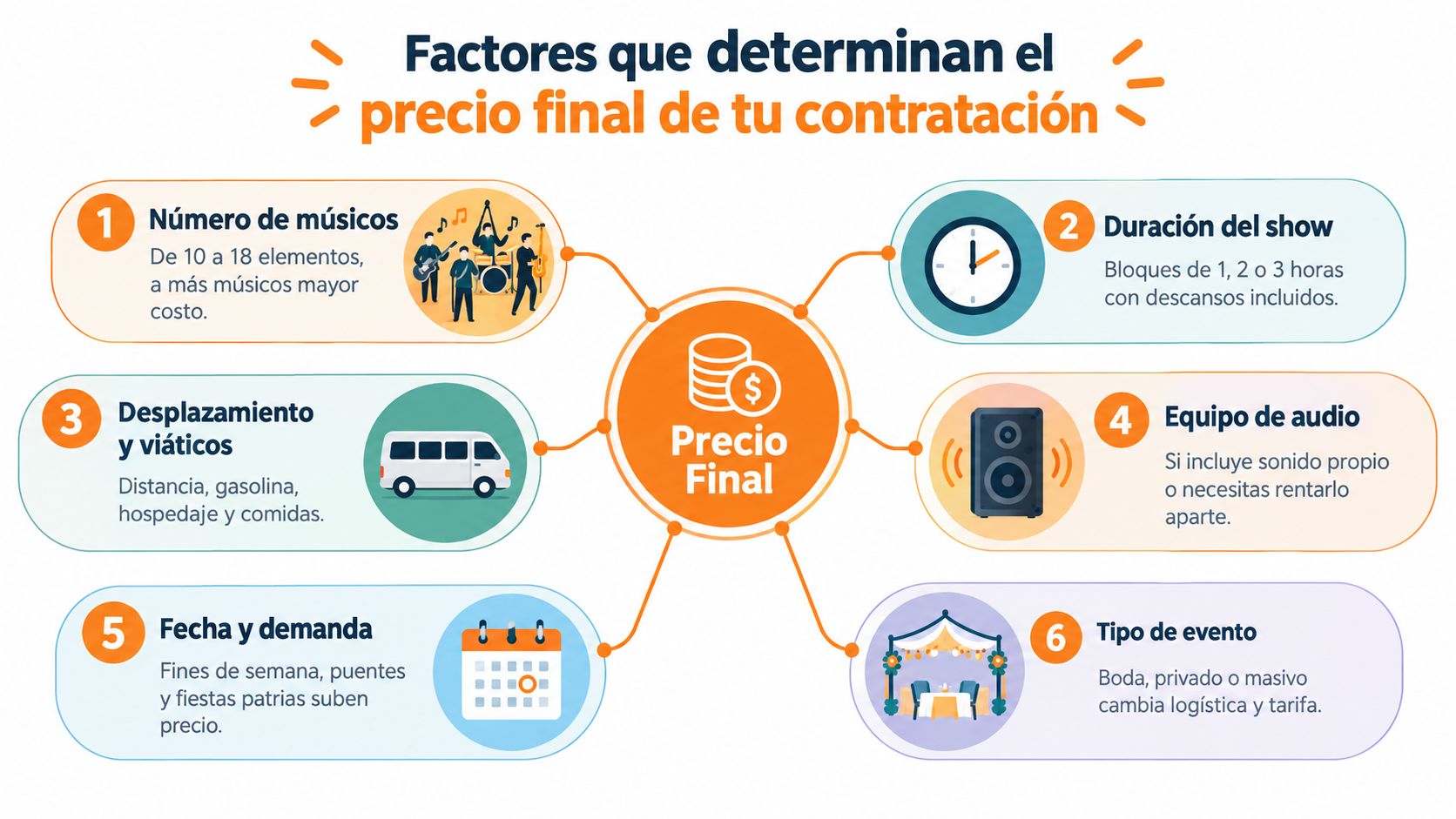
The price of a Sinaloan banda is structured like a bill by parts: musicians, performance hours, travel, and equipment. Separating each component allows you to compare proposals and detect what the rate really includes. A low quote may exclude sound or expenses, while a higher one might already cover those costs.
Number of Musicians
The formation changes the cost from the start. A banda with 12 to 16 members implies more individual fees, transportation, and coordination than a reduced group. Request that the proposal indicates how many musicians will attend and what instruments each will bring.
The size should also match the space. For an intimate gathering, a small lineup can cover the atmosphere without overwhelming the place. At a crowded party, a full banda can better sustain the sound presence. It's similar to organizing transportation for a group: each additional person requires space, routes, and well-coordinated times.
Duration and Show Blocks
The contracted hour doesn't always equal an hour of continuous music. Confirm if the time includes breaks, waiting, pauses between blocks, and participation in special moments.
An event may require a brief intervention to welcome guests, a block during the meal, and another to open the dance. Although the total music may be similar, separating the performances requires returning to the stage and coordinating schedules. Ask that the quote specifies the duration of each block and the total presence of the banda.
Travel and Expenses
Distance adds transportation, fuel, and, in some cases, meals or lodging. That's why an attractive rate can change when the celebration takes place outside the usual area.
Share the city, venue, arrival time, and conditions for parking or unloading instruments from the first message. The guide on how to quote transportation and expenses for out-of-town events helps organize these details and avoid vague agreements.
Audio and Lighting
Some bandas bring their own equipment; others work with the venue's provider or require a separate rental. This difference modifies the budget and defines who installs, operates, and resolves any problems during the performance.
Ask if the price includes speakers, microphones, console, monitoring, and lighting. If the venue already has sound, confirm that it's compatible with the lineup and who will be in charge of managing it. “There is sound” doesn't describe by itself what the banda needs.
Date and Demand
Weekends, holidays, and national celebrations often concentrate requests. Availability can limit the format, schedule, or repertoire, even if the budget is defined.
Contact in advance and ask that the quote indicates its validity. This way, you can compare proposals with the same conditions and know what happens if the date changes.
Repertoire and Special Requests
Dedicated songs, a bride and groom entrance, or a prepared intervention require coordination. Some requests are part of the usual repertoire; others may need rehearsal, adaptation, or additional time.
Provide a brief list of priority songs and indicate which moment each should accompany. With this information, the banda can calculate the real work and present a clear formula, instead of responding with a generic rate.
Real Price Ranges by Type of Service and Duration
To estimate how much it costs to hire a Sinaloan banda, break down the bill into four pieces: musicians, performance hours, travel, and equipment. A serenata is like requesting a specific intervention; a wedding requires reserving more time and coordinating a larger production. That's why comparing both services only by duration can lead to incorrect conclusions.
| Mode | Duration | Range MXN |
|---|---|---|
| Hourly Service in Sinaloa | 1 hour | $6,300 MXN per hour |
| Serenata | Brief Service | $4,562 MXN |
| Extra Song | Per song | $360 MXN |
| Banda of 12 to 16 Musicians | Per event | $15,000 to $60,000 MXN |
| Banda of 12 to 16 Musicians for Wedding | Block of 2 to 4 hours | $18,000 to $60,000 MXN |
The Sinaloa rates appear in the official reference for musical group costs. The range for large bandas and weddings corresponds to a price guide projected for 2026.
How to Read the Table
The serenata covers a specific moment. Its price may include a limited number of songs, musicians, and waiting time. A wedding, on the other hand, may gather a larger lineup, a prolonged block, and setup needs. The final figure depends on what each proposal includes.
The hourly rate doesn't work as a simple multiplication either. A brief performance can retain preparation, travel, and availability costs. In a longer package, these concepts are spread within the hire, like dividing the cost of a kitchen among several dishes instead of charging it to just one.
Why the Range is Wide
Between the lowest and highest price, different formats fit. The number of musicians, the city, the date, the equipment, and the program's complexity change. Request a quote that breaks down these elements, even if the provider delivers a closed price.
To compare a wedding with other events, check out this guide on rates for playing at weddings and events in Mexico. Bring the table to the conversation and ask each provider to confirm musicians, hours, travel, and equipment included.
Budget Examples for Wedding, Private Party, and National Holiday Event
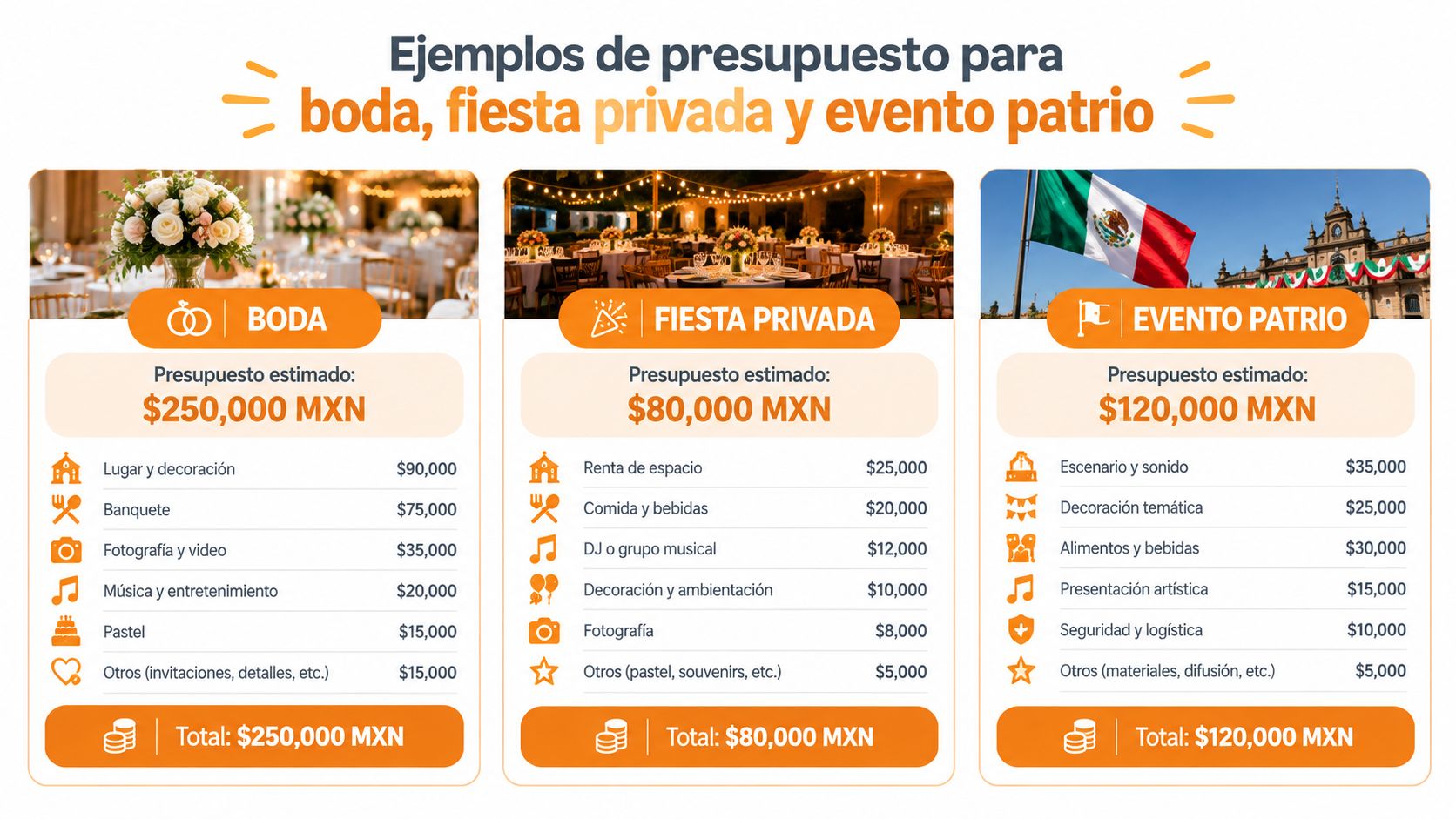
These scenarios help build a bill before requesting a quote. The formula is simple: musicians + performance hours + travel + equipment. Each group distributes its costs differently, so the breakdown serves to compare proposals, not to replace them.
Wedding with a Banda of 15 Musicians
For a wedding, the 2026 reference places a banda of 12 to 16 musicians between $18,000 and $60,000 MXN for a block of 2 to 4 hours, according to the reference cited in the introduction.
Suppose a hire of 15 musicians for 3 hours, with audio, setup, and local travel. The message can be direct: “I request a closed quote for 15 musicians, 3 hours, audio, setup, and local travel.” Ask that the response indicates what part corresponds to the musicians and time, and what part covers the equipment or travel.
It's not advisable to divide the total among musicians or hours as if it were a fixed bill. That operation is like splitting the cost of a meal among dishes: some expenses exist even if the block is short. If you need to adjust the budget, first compare less musical time, a compact lineup, or audio hired separately, as long as the venue allows it.
Private Party at Home
A home party can reduce the production, but complicates access. Stairs, limited parking, neighbors, and little space for the tambora change the loading time and the amount of equipment needed.
Request the price for a defined format, during the required block, with local travel and described equipment. As a 2026 reference, a banda of 12 to 16 musicians appears in a range of $15,000 to $60,000 MXN. Use that data to check if the proposal considers musicians, hours, travel, and sound, not to assume that all groups charge the same.
In a small gathering, you can concentrate the music at the central moment, reduce additional equipment, or choose a more compact lineup. Confirm that the change retains the intensity and repertoire you expect.
One-Hour National Holiday Event
In Sinaloa, the documented reference marks $6,300 MXN per hour and $360 MXN per extra song. If the act lasts exactly one hour, ask how many songs the block includes and if additional ones are charged separately. Leave it written in the proposal.
The total can change if the rate covers only the performance or also the sound and travel. To review what data is worth asking for in a private party, check this band hire guide. The final bill should unite musicians, duration, travel, and equipment confirmed by the group.
How to Negotiate and Hire Without Overpaying
At a wedding, the organizer usually receives a figure that seems reasonable, but changes when travel, sound, or an additional hour appear. To avoid surprises, negotiate the scope of the service, not just the price. A complete message allows the banda to calculate a useful proposal from the start.
Indicate date, city, venue, type of event, schedule, duration, approximate guests, desired format, and if you already have sound. Add access restrictions, available time for setup, and any song for a special entrance. These data work like the ingredients of a recipe: if one is missing, the result can change.
Ask for the Breakdown in Writing
Request a quote that separates musicians, hours, breaks, setup, equipment, travel, expenses, and special requests. If any concept is not included, it should appear as such, instead of being subject to interpretation. With that breakdown, you can compare two proposals offering the same service.
Mariiachi.com allows you to review videos, repertoires, reference prices, and reviews, as well as contact the musician or representative directly. The site serves to locate performers by genre, location, and instrumentation, but availability, repertoire, and final conditions are confirmed with the group.
Five Points Before Paying
- Exact schedule: Confirm arrival, setup, start, breaks, and departure.
- Contracted format: Specify how many musicians will attend and what instruments they will bring.
- Equipment: Clarify if audio and lighting are included or rented separately.
- Travel: Define transportation, parking, meals, and lodging when applicable.
- Payment and cancellation: Request in writing the deposit, balance, changes, and cancellation.
Don't hand over money based solely on an informal conversation. The agreement must identify the responsible person, describe the service, and set its main conditions. To organize the hire, check this musical group hire guide.

Before confirming, ask: “What would have to change for the price to increase?” The answer reveals if the cost depends on more hours, musicians, distance, equipment, or special requests. This way, you can adjust the service before the event and avoid unexpected charges.
Conclusion: Find Your Ideal Banda Sinaloense at Mariiachi.com
Knowing how much it costs to hire a banda sinaloense requires breaking down each component of the quote: musicians, duration, travel, equipment, date, and special requests. This way, you compare equivalent services, not just numbers.
For a short gathering, a small band for a few hours might be enough. At a wedding, the budget changes if you need more musicians, longer duration, audio, or travel outside the city. Each element acts as a piece of the bill: if one increases, the total may also change.
Ensure the format matches the size of the event, that the repertoire suits your guests, and that the proposal specifies what is included. Videos, repertoire, and reviews help verify the style and experience in similar celebrations.
If you already have a date and city, send that information in the first message. Request two or three comparable proposals and ask them to separate musicians, hours, transportation, and equipment. This review allows you to adjust the service before booking the date and reduces unexpected charges.
At Mariiachi.com, you can search for bands by genre, location, and format, review videos, repertoires, reference prices, and reviews, and contact the musicians directly. Filter the options suitable for your event and request an itemized quote.