
The music that accompanies each moment can unite a ceremony, a cocktail, and a dinner without competing with vows, toasts, or conversations. If you are planning your wedding, you probably already have important songs for you, but not all work with vocals, at the same volume, or in any space. An instrumental version retains the melody and emotion, while removing the lyrics to create a more elegant and flexible atmosphere.
The right decision depends on the moment of the event, the space, the acoustics, the repertoire, the ensemble, and the budget. In Mexico, live entertainment ranks among the top investment areas for many couples, and live music is used both in the ceremony and the reception, according to the sector analysis of live music for weddings in Mexico. To compare options, Mariiachi.com allows you to search for musicians by instrument, genre, and location, review videos, reference prices, and reviews before contacting the performer directly.
Table of Contents
- 1. Classic Mariachi Without Vocals
- 2. Classical and Contemporary Music for String Quartet
- 3. Banda Sinaloense Without Vocals
- 4. Solo Classical Guitarist
- 5. String Trio with Violin, Cello, and Piano
- 6. Contemporary Jazz Without Vocals
- 7. Saxophone and Piano Duo
- 8. Solo Classical Harp
- Comparison of 8 Instrumental Music Options for Weddings
- Turn Your Repertoire into a Tailored Experience
1. Classic Mariachi Without Vocals
Mariachi works when you're looking for a Mexican, solemn, and warm wedding without turning every moment into a concert. Its violins, trumpets, guitarrón, and vihuela maintain the genre's identity while leaving room for the ceremony and cocktail conversations.
Its best use is during the entrance, signing of the marriage certificate, church exit, and guest reception. Request instrumental versions of traditional pieces, boleros, romantic songs, or contemporary melodies important to you. This way, you keep the melody's emotion without imposing lyrics during a religious or civil moment.
The ensemble should match the space. A small group suits a cocktail in a contained area; a larger formation has presence for a garden, a hacienda, or a large exit. Also define if they will play only during the ceremony, during the cocktail, or in both moments, as this decision affects duration and budget.
What to Check Before Hiring
- Repertoire: Request a list that combines Mexican classics and modern arrangements. Mark pieces for entrance, signing, exit, and cocktail.
- Adaptation: Confirm which songs with lyrics can be turned into instrumental arrangements and who will prepare them.
- Volume: Ask if they can play in an ambient format and reserve full power for the exit or reception.
- Sound: Check if they bring their own equipment and what the venue must provide.
- Experience: Review videos of performances and wedding reviews, and consult the history of mariachi.
Rule of thumb: Don't hire the mariachi just for its image. Listen to how it sounds without vocals and request an exact program for each moment.
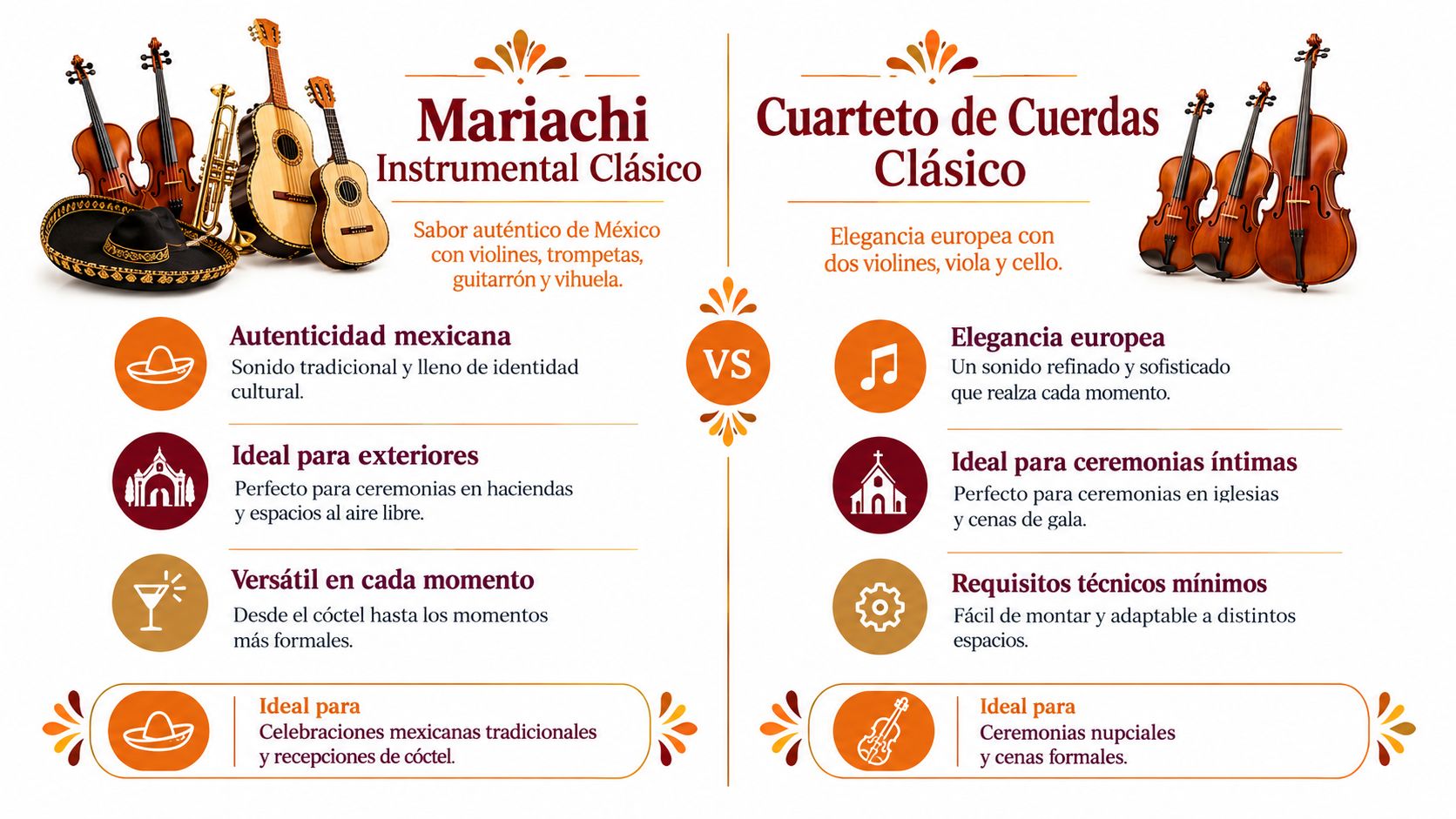
2. Classical and Contemporary Music for String Quartet
A string quartet brings elegance without visually occupying the space. The combination of violins, viola, and cello can perform classical repertoire, religious pieces, chamber music, and arrangements of current songs. Its sound fits ceremonies in churches, gardens, hotels, and formal dinners.
For the bride or couple's entrance, the quartet can start with a contained dynamic and grow as the procession advances. During the signing of the certificate, it's advisable to choose soft and recognizable melodies. At the cocktail, arrangements of popular songs make the repertoire feel familiar, even if the formation maintains a classical aesthetic.
Don't assume that any quartet will work the same in any venue. A church with reverberation can naturally amplify the strings, but a large hall or garden may require technical support. Before closing, request a modular budget for ceremony, cocktail, and dinner. The market guide cited earlier places the string quartet between $9,000 and $18,000 MXN for ceremony and cocktail, a useful range for comparing proposals with the same scope.
How to Personalize the Repertoire
Request a mix of well-known pieces and classical works. Bach, Mozart, and Vivaldi can coexist with arrangements of a pop song, a bolero, or a movie melody. If the song has very important lyrics for you, explain to the group what emotion you want to preserve, not just the title.
For a civil wedding, you can also take ideas from music for civil weddings and turn them into a program that accompanies the entrance, signing, and exit without abrupt style changes.

Request videos recorded at real ceremonies, confirm the dress code, and check if the musicians need chairs, music stands, lighting, or amplification.
3. Banda Sinaloense Without Vocals
The banda sinaloense brings rhythm and Mexican character without relying on a lead voice. Its brass and percussion have a festive presence, making it best suited for the ceremony exit, a lively cocktail, the entrance to the hall, or a garden reception.
For a solemn ceremony, choose contained arrangements and leave intense themes for after the signing. During dinner, it can act as background if it accepts moderate volume and clear pauses. Continuous and loud performance makes conversations difficult and competes with speeches.
The format suits couples seeking regional music with more sonic breadth than an acoustic ensemble. The number of musicians alone does not determine the outcome. Review the repertoire, break organization, and coordination with the DJ to avoid an overloaded party.
Coordination with the Venue
The space defines the experience. Confirm where the brass, percussion, cables, and staff circulation fit. A patio can accommodate the band well, while a small terrace requires precise distribution. Before signing, review setup, volume limits, and guest location.
- Repertoire: Request a list separated by ceremony, cocktail, meal, and party, with different energy levels.
- Songs with lyrics: Request arrangements that keep the melody recognizable, even if played without vocals. For pieces intended as background music, prefer shorter and contained versions.
- Breaks: Agree on pauses to facilitate conversation and catering team work.
- Transition: Define when the DJ enters and who will signal the music change.
- Test: Review wedding videos and ask if the group can play in an ambient format, with less intensity.
If comparing regional proposals, consult the guide on how much it costs to hire a banda sinaloense and request a quote adjusted to the moments you want to cover. Also confirm chairs, meals, electricity, and technical needs before hiring.
4. Solo Classical Guitarist
The classical guitar is the most intimate option on this list. A single performer can accompany the arrival of guests, the bride's entrance, the cocktail, or a quiet dinner without setting up a large production. Its timbre works particularly well in small gardens, terraces, haciendas, and boutique weddings.
The repertoire can range from pieces by Francisco Tárrega and Andrés Segovia to arrangements of romantic songs, boleros, and popular themes. For songs with lyrics, request a version that maintains the main melody and clear harmony. There's no need to fill every pause. The value of this format lies precisely in creating a discreet musical background, with moments of silence that allow the event to breathe.
Requesting personalized songs greatly improves the result. Choose three to five meaningful melodies and explain when you want to hear them. One can accompany the entrance, another the signing, and the others the cocktail. The guitarist can decide if a complete adaptation, a specific introduction, or a shorter version is needed.
Details That Change the Experience
- Location: Place them near the entrance or cocktail area, where guests can see them without blocking the way.
- Sound: In small spaces, try the instrument without amplification first. Outdoors, confirm an appropriate microphone.
- Photography: Inform the photographer where they will be to use the instrument as part of the scene.
- Repertoire: Review videos of complete technique and arrangements, not just promotional snippets.
For a wedding in the capital, you can guide your search with this guide for hiring a guitarist for events in Mexico City. Direct contact allows you to confirm availability, transportation, duration, and technical needs without assuming all guitarists work under the same conditions.
5. String Trio with Violin, Cello, and Piano
The trio of violin, cello, and piano offers a fuller texture than a soloist but maintains an elegant presence. The piano provides harmonic structure, the cello adds depth, and the violin can lead the melodies for entrance, signing, or dinner. It is a suitable formation for a wedding that wants continuous and emotional music at various moments.
Its best setting is a hotel with a piano available, a private restaurant, or a hacienda with enough space. If the piano belongs to the venue, they must confirm its condition, location, and access before hiring. Not all halls have a suitable instrument or allow it to be moved. They also need to ensure the group can set up without interfering with food service.
Songs with lyrics work when the arrangement leaves the theme recognizable but doesn't try to mimic a vocal performance. For the ceremony, select slow and clear melodies. At dinner, use pieces with moderate movement and avoid overly dramatic changes that distract from speeches.
A Proposal Worth Requesting
Request a program separated by moments:
- Ceremony: entrance, signing, and exit.
- Cocktail: well-known arrangements with light energy.
- Dinner: elegant repertoire that allows conversation.
- Special moment: a song chosen by you, with a personalized introduction.
The platform can help you locate music for weddings in Spanish and identify violinists who work with pianists or cellists. Confirm that the three musicians have played together. A good formation depends not only on individual quality but also on coordination among its members.
The piano is not a decorative detail. If the venue doesn't have one available and tuned, the budget and logistics change completely.
6. Contemporary Jazz Without Vocals
For a cocktail on a rooftop, a dinner in a contemporary restaurant, or an after-party in a lounge space, jazz provides an urban, sophisticated, and relaxed atmosphere. Choose a trio or quartet depending on the venue: saxophone, piano, double bass, and drums offer more variety but also require more space and volume control.
Romantic songs, jazz standards, and pop melodies allow arrangements with modern harmonies. If you want to keep a song with lyrics recognizable, ask the saxophone or piano to maintain the melody. The rhythm section can change the character without erasing the original theme.
The decision depends on the moment. For dinner, hire an ambient format and limit intense solos. Reserve more energy for the cocktail or after-party. In a closed hall, the drums, double bass, and saxophone can quickly grow, so agree on the volume before signing. Also define if they accept requests or work with a closed repertoire.
What to Check Before Hiring
- Repertoire: Request the complete list and mark the songs you want to adapt.
- Equipment: Confirm microphones, mixer, monitors, and electrical connections.
- Arrangements: Ask if they can prepare a specific song and how much time they need.
- Sound check: Demand a full review with the venue's equipment, not just a quick check.
On Mariiachi.com you can search for profiles of saxophonists or keyboardists with jazz experience, watch live videos, and contact the group to verify musical compatibility. Request videos of the complete ensemble, not just individual musicians. In an urban wedding, the arrangement should fit the event's ambiance and image.
7. Saxophone and Piano Duo
For a ceremony in a small space, a quiet cocktail, or an intimate dinner, the saxophone and piano duo offers live music without taking up the space of a full band. Its sound combines warmth, romance, and modernity, but works best when the repertoire and volume are adjusted to each moment.
The saxophone keeps the melody of a song with lyrics recognizable, while the piano provides harmony and movement. For the bride's entrance, request a soft introduction and a defined closure. At the cocktail, arrangements with more rhythm fit. During dinner, request discreet performances so the music accompanies the conversation.
The format also solves weddings with space constraints. Place the musicians near the entrance or at one end of the hall, visible for photos and out of the way of waiters and guests. If you want music throughout the reception, confirm they can change intensity without losing clarity.
Before hiring, review these points:
- Saxophone: Confirm if the performer uses tenor, soprano, or both saxophones, and choose the timbre that fits the ambiance.
- Piano: Ask if they will play an acoustic piano, a keyboard, or an instrument provided by the venue.
- Repertoire: Request adaptations of romantic songs, jazz standards, and important pieces for you, with the melody identifiable.
- Compatibility: Listen to videos where both musicians appear together, not separate profiles.
- Sound: Clarify the necessary amplification and request a test at the venue to avoid distortion.
Before signing, agree on signals to start, end, and hand over the space for speeches or readings. Choose the duo for their ability to adapt to the environment, not just for the little space they occupy.
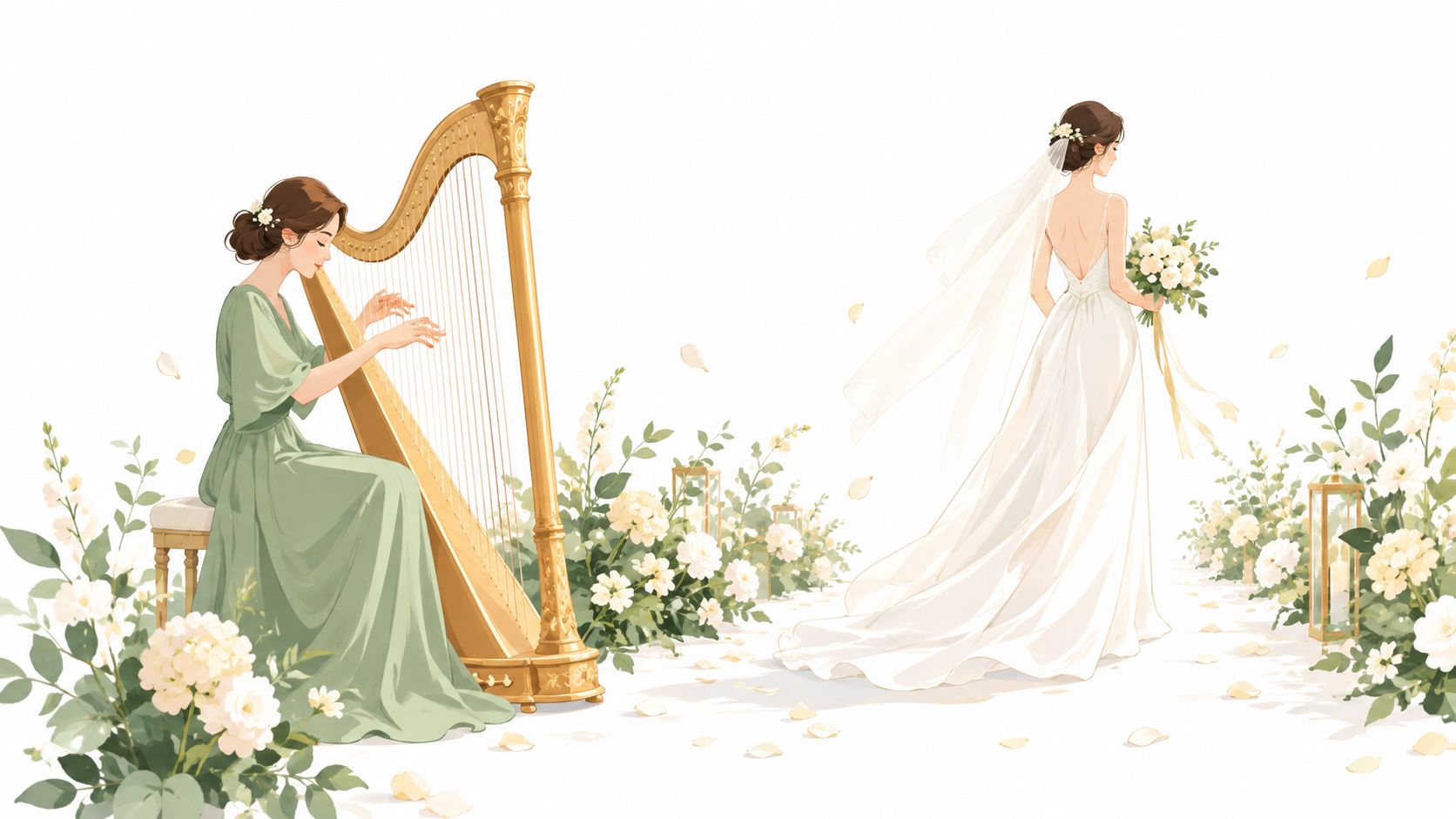
8. Solo Classical Harp
If the ceremony takes place in a church, a hacienda, or a garden, the harp can become part of the setting and not just background music. Its delicate timbre accompanies religious repertoire, classical pieces, Celtic music, and popular songs adapted without lyrics. The melody remains recognizable, even if the voice disappears.
For the bride's entrance, it's advisable to choose an arrangement with a clear start and agreed duration. In a religious ceremony, request the venue's list of allowed pieces before preparing the repertoire. In a civil wedding, combine a classical work with a song meaningful to you. During the cocktail, lighter versions that allow conversation will work better.
The harp requires different planning than a guitar or a compact format. Before booking, review access for transport, setup space, floor stability, and protection against bumps. Outdoors, wind and ambient noise can reduce its sound presence, so they should assess the location during a prior visit.
Also define how to leverage its visual presence:
- Location: Place it where it can be seen, without blocking the aisle or the waiters' work.
- Photos: Inform the photographer of its location to integrate it into the arrival images.
- Sound: Test the venue's acoustics and confirm if amplification is needed.
- Repertoire: Request samples of religious, classical, and popular pieces, with and without adapted lyrics.
- Operation: Agree on access route, setup, storage, arrival time, and breaks.
On Mariiachi.com, you can search for string instrument performers or request direct references. Compare videos, photos, repertoire, and hiring conditions before choosing this option, especially if the space presents wind, narrow paths, or irregular acoustics.
Comparison of 8 Instrumental Music Options for Weddings
| Option | Complexity 🔄 | Resources ⚡ | Expected Results 📊 | Ideal Cases 💡 | Key Advantages ⭐ |
|---|---|---|---|---|---|
| Classic Instrumental Mariachi | High, requires technical musicians and arrangements | Medium-high, full ensemble (violins, trumpets, guitarrón, vihuela); high budget | High cultural authenticity; elegant atmosphere that allows conversation | Formal weddings, religious ceremonies, cocktail hours at haciendas and outdoors | Immediate cultural recognition; very versatile for photos/broadcast |
| Classical Music / String Quartet | Medium, coordination of four trained musicians | Medium, 4 musicians; minimal equipment; high cost per musician | Elegance and solemnity; ideal for emotional moments (bride's entrance) | Nuptial ceremonies, formal dinners, churches with good acoustics | Intimate and consistent sound; minimal technical infrastructure |
| Instrumental Banda Sinaloense | Medium, brass and percussion sections require coordination | Medium, several brass and percussion; possible amplification; more accessible budget | Festive and rhythmic atmosphere; facilitates dancing without being deafening | Weddings with young/traditional audiences, cocktail hours with dancing, open spaces | High energy and wide regional availability; competitive cost |
| Solo Classical Guitarist | Low, one musician, simple logistics | Low, 1 performer; minimal amplification; accessible budget | Intimacy and sophistication; excellent for transitions and cocktail hours | Cocktail hours, intimate dinners, entrances in small gardens | Economical, easy to coordinate and photogenic |
| String Trio (Violin, Cello, Piano) | Medium, requires coordination and space for piano | Medium-high, ideally available piano; moderate budget | Rich and warm sound; balance between volume and intimacy | Formal wedding dinners, ceremonial moments, halls with piano | Versatile for personalized arrangements; great audiovisual impact |
| Contemporary Instrumental Jazz (Trio/Quartet) | Medium-high, improvisation and technical sensitivity | Medium-high, specialized musicians; drums imply sound technique; medium-high budget | Sophisticated and modern atmosphere; elegant background that allows conversation | Urban cocktail hours, rooftops, boutique weddings and after-parties | Fresh and distinctive; adaptable in repertoire and dynamics |
| Saxophone and Piano Duo | Medium, intimate coordination between two musicians | Medium, quality piano or keyboard; moderate budget | Warm and emotional atmosphere; versatile between jazz, bolero, and pop | Cocktail hours, romantic dinners, entrances in medium spaces | Good cost-impact ratio; easy transport and setup |
| Solo Classical Harp | High, specialized musician and instrument logistics | High, scarce harp and harpist; requires space; high budget | Unique sound and visually striking; creates magical atmospheres | Luxury weddings, religious ceremonies, key emotional moments | Very distinctive and photogenic; minimal need for amplification |
Turn Your Repertoire into a Tailored Experience
The best wedding music isn't the loudest, but the one that fits each scene. Assign a format to each moment before requesting quotes. For instance, a quartet or harp for the ceremony, guitar or saxophone and piano duo for the cocktail hour, and mariachi or banda sinaloense for the exit and reception.
Then, separate the songs into two groups. The first gathers pieces without vocals, like classical works, boleros, or jazz compositions. The second contains well-known melodies you want to hear without vocals. In this latter case, request arrangements that retain the main theme. A vocal-free version shouldn't sound like a generic track: it should allow guests to recognize the song without the lyrics dominating the moment.
Select three to five customized pieces and define where each will appear. Provide titles, reference versions, and the emotional tone you seek. Also indicate if you prefer a brief introduction, a gradual entrance, or an exit with more energy. The musician will be able to respond more accurately when given specific instructions.
What Should Be Put in Writing
- Duration: Specify how long the group will play and when breaks will occur.
- Volume: Define different levels for ceremony, cocktail hour, dinner, speeches, and party.
- Space: Confirm approximate measurements, location, chairs, stands, lighting, and access.
- Equipment: Clarify who provides amplification, microphones, piano, keyboard, and electricity.
- Repertoire: Include approved songs, prohibited pieces, and room for requests.
- Coordination: Establish signals for entrance, signing, exit, toast, and switch to DJ.
The budget should be compared by coverage, not just by rate. For a formal wedding of 80 guests or more, a market guide considers it realistic to start from $20,000 MXN when combining ceremony, cocktail hour, and reception, as explained in this live music guide for weddings. Request quotes with the same moments to know what each group truly offers.
It's also advisable to review the offer according to location. A Mexican directory records 887 wedding music results in Mexico City and 655 in Jalisco, according to the wedding music directory. This concentration makes it easier to compare instrumentation, videos, reviews, and availability in those markets, while in other areas, you must confirm transportation and setup times more carefully.
Mariiachi.com gathers profiles of mariachis, bands, saxophonists, keyboardists, guitarists, and violinists with public information to start that comparison. Watch the full video, read the reviews, verify the repertoire, and contact the musician directly to confirm the real conditions of your wedding. The final decision should answer a simple question: will this format make each moment feel the way you want to experience it?
Explore Mariiachi.com to find musicians by instrument, genre, and location, and compare videos, repertoires, reference prices, and reviews. Contact the performers directly to confirm availability, adapt your songs, and secure the right music for each moment of your wedding.