
Music also sets the pace for the ceremony. If you're planning a civil wedding, you've likely encountered the most deceptive part of organizing: it seems easy to choose "a few songs," but once you consider the entrance, signing, exit, cocktail, and reception, real doubt arises. What sounds good without drowning out the officiant, what works in a small restaurant, what's worth paying for live, and what moment might be better with recorded audio.
Moreover, a civil wedding almost always requires more precision than a large wedding. The procession is short, transitions are quick, and any excess volume is immediately noticeable. That's why there's no single ideal format for the entire day. The best music for civil weddings comes from effectively combining five variables: moment, atmosphere, space, budget, and level of personalization.
This also explains why music weighs so heavily in the couple's decision. A survey cited about weddings in Mexico reported that 91% of couples said "I can't imagine my wedding without music," and that music represents 10.5% of the total wedding cost, surpassing photography and decoration, according to the registry cited by INEGI. It's not a secondary detail. It's a central part of how the event is experienced.
Here are eight options ordered according to the real flow of a civil wedding. They range from an entrance with mariachi to a hybrid with DJ, sax, guitar, and playlist. The idea is not to sell you "the complete package," but to help you decide what works and what doesn't in each section. If you want to compare before requesting a quote, a useful review is to watch videos, read reviews, and check reference repertoires and prices on public profiles like those gathered by Mariiachi.com.
Index
- 1. Classic Processional with Mariachi and Traditional Variations
- 2. Festive Recessional with Cheerful Exit and Livelier Tempo
- 3. Cocktail with Bolero and Latin Jazz Live or Recorded
- 4. Romantic First Dance with Customized Arrangement
- 5. Classical Guitar for Formal Reception
- 6. Themed Banda Playlist for Recorded Party
- 7. Solo Saxophonist for Key Moments
- 8. Hybrid with DJ and Mariachi for a Dynamic Transition
- Comparison of 8 Musical Options for Civil Weddings
- Turn Your Selection into a Surprise-Free Music Plan
1. Classic Processional with Mariachi and Traditional Variations
The scene is very specific. The officiant is ready, the family is late getting settled, and the entrance lasts less than a minute. In that short stretch, a well-coordinated mariachi can add character without weighing down the ceremony.
"Cielito Lindo" usually works if you request a sober version, with a clear start and contained tempo. "El Son de la Negra" can serve in a more secure and ceremonial entrance, as long as the arrangement trims the most festive part. "Viva Mexico" fits better when the civil wedding has an open-air format, and the couple wants a more visible signal from the first beat.
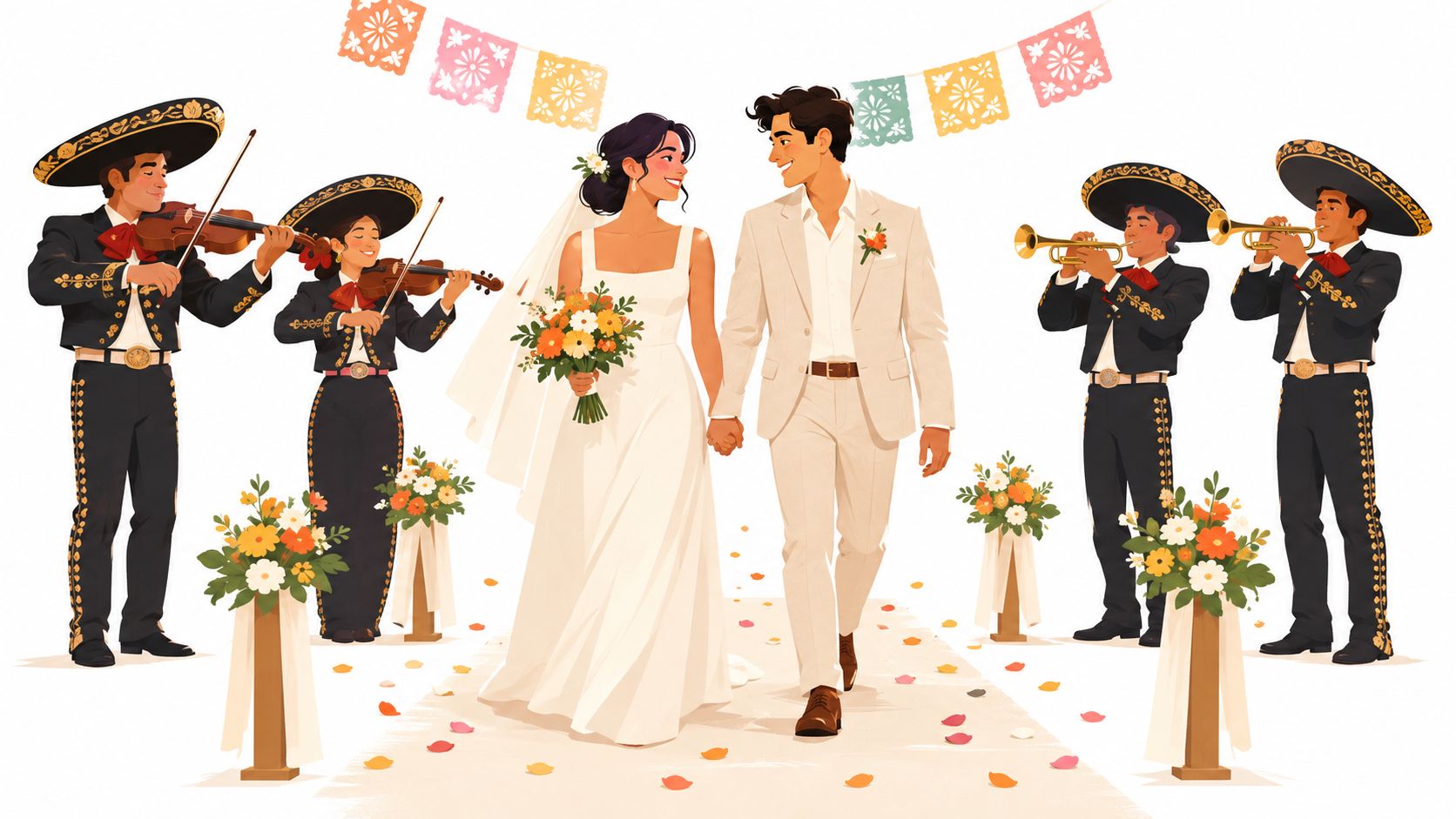
Here the problem is usually not the song. It's often the actual duration of the procession. I've seen entrances of 25 seconds with introductions designed for three minutes, and also the opposite: the piece ends, the bride is only halfway down the aisle, and no one knows if the group should repeat, cut, or wait in silence. In a small civil wedding, that mismatch is very noticeable.
It's advisable to define three things before hiring or finalizing the repertoire:
- How long the actual walk lasts: measure it with the pace you'll have that day, not with an estimate.
- From which beat the couple enters: some pieces work better if the mariachi starts playing right away, others if they wait for a signal.
- Where the musicians are positioned: near the aisle gives presence, but in a small room, it can also drown out the officiant's voice.
Requesting "mariachi for entrance" isn't enough. What's useful is asking for a ceremony arrangement, short, with a clear ending and controlled volume. That detail separates a group that handles a civil wedding well from one that plays the same as in a restaurant or long party.
If you're still comparing options, review full videos, reviews, and real repertoires before writing. On public profiles like those gathered by Mariiachi.com, you can quickly detect if the group knows how to handle formal entrances or just party moments. It also helps to listen to how they manage dynamics, tuning, and endings, not just what songs they claim to play.
Practical rule: if the officiant will speak without a microphone, request a format that knows how to play with restraint and can adjust structure and volume according to the space.
This option works very well when the couple wants an entrance with Mexican identity and a recognizable moment from the start. It loses strength in very small terraces, almost non-existent aisles, or with groups that don't accept adapting duration, tone, and placement.
2. Festive Recessional with Cheerful Exit and Livelier Tempo
The scene is very specific. The officiant finishes, the couple kisses, someone starts clapping before the rest, and if the music enters half a second late, the exit loses impact in photos and videos. In a civil wedding, that stretch is brief, so it's best treated as a performance piece, not just a pretty song.
Here, themes with a recognizable start and clear pulse usually work better. "El Son de la Negra" continues to work well because the family recognizes it instantly and helps the exit have momentum without needing explanation. "Viva Mexico" can also work, but it depends heavily on the arrangement and the type of ceremony. If the act was sober and short, an overly explosive version can feel disproportionate.
What truly changes the outcome is defining the exit order. There are three points to finalize with the group and the event coordinator:
- The exact start signal. "As soon as the officiant says spouses" or "after the kiss."
- The actual route. It's not the same to walk ten steps and stop for a petal shower as to cross an entire garden.
- The ending. It can be abrupt upon reaching the door or with a flourish while greeting the first row.
I don't recommend improvising in this part. If the mariachi plays as if they were at a long serenade, the exit stretches too much and becomes disorganized. If it cuts too soon, the couple is left walking without musical support. The professional approach is to request a brief version, with a clean entrance and rehearsed ending.
It also helps to decide the format according to the space. A full mariachi gives presence and makes the exit feel celebratory immediately, but in small rooms or patios with a lot of reverberation, it can sound bigger than necessary. A reduced format, for example with fewer musicians, loses some visual impact but gains control. That trade-off is worth evaluating before hiring.
To choose repertoire, videos, and execution styles, Mariiachi.com serves as a preliminary filter. It allows you to compare profiles, reviews, repertoires, and reference prices before contacting directly. If you also want to review well-known songs for this moment, at most requested mariachi songs you can see options that usually work for festive exits.
A practical detail that many couples overlook: the exit also depends on the photographer and video. If there will be petals, bubbles, or a hug with parents at the end of the aisle, the group should know to sustain a few extra beats without lengthening the entire piece. That's where you can tell who has worked civil weddings before and who just adapts party repertoire.
It works very well in ceremonies that want a clear change between the legal moment and the celebration. It loses meaning in very discreet weddings, with strong volume restrictions, or with routes so short that there's barely time for the song to take off.
3. Cocktail with Bolero and Latin Jazz Live or Recorded
The signing ends, the first drinks are served, and the atmosphere changes completely. Here, the cocktail needs music that accompanies without pushing too hard. If it falls short, the space feels cold. If it goes overboard, it forces people to raise their voices and breaks what this section should facilitate: conversation, greetings, and photos at a relaxed pace.
That's why soft bolero, light Latin jazz, and well-known versions with discreet arrangements usually work best. There's no need to fill this moment with memorable songs one after another. Continuity, good volume, and a repertoire that doesn't compete with conversation are needed. In intimate civil weddings, a well-chosen soloist often resolves more than a poorly balanced large group.
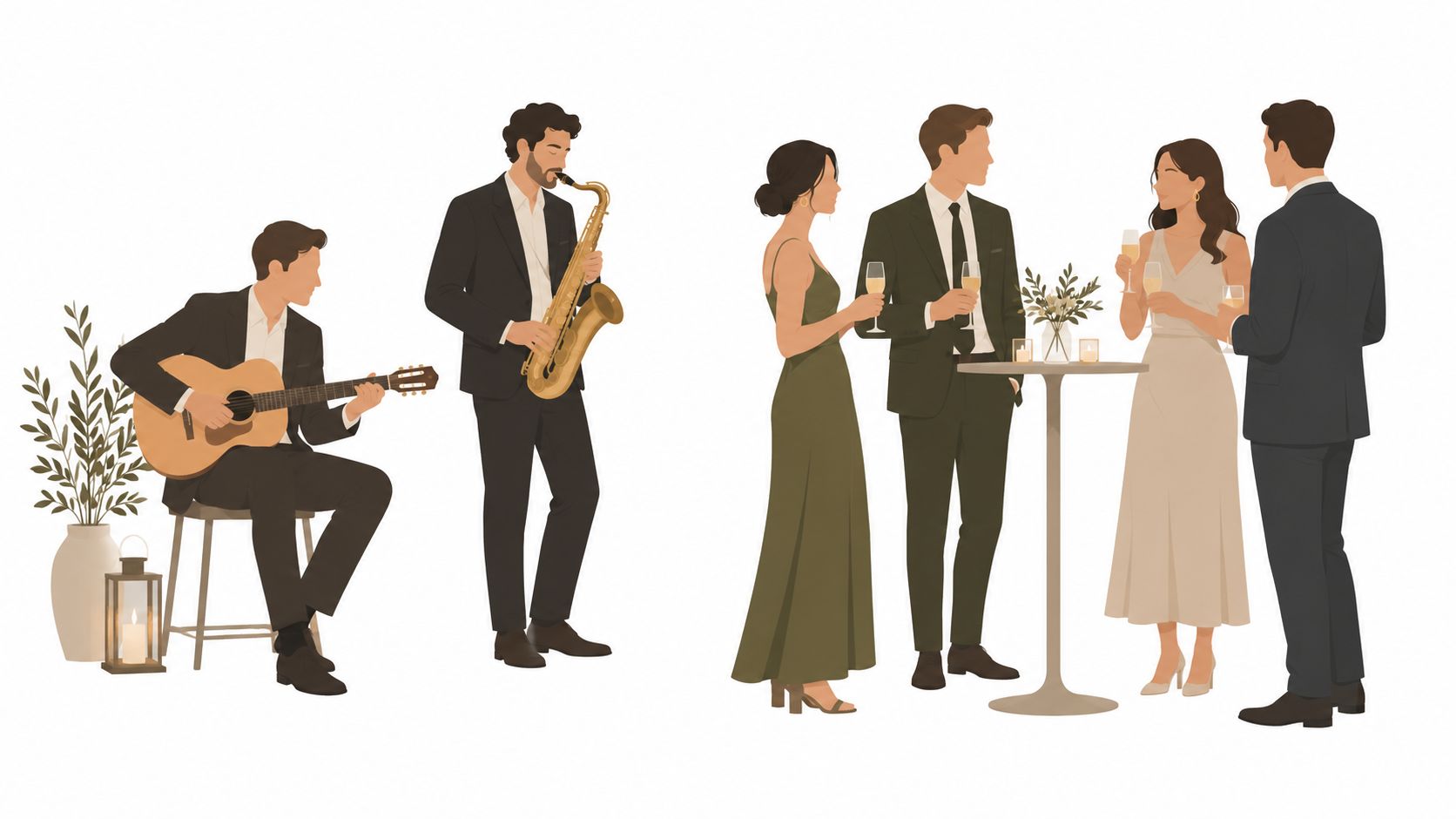
There are three practical decisions here: format, duration, and audio source.
If the cocktail will be short or the budget is already spent on ceremony and party, a well-crafted playlist works. It requires more care than it seems. It's advisable to order blocks of 20 to 30 minutes with a similar color, avoid abrupt changes in era or energy, and test the real volume at the venue. An improvised list usually fails because of this, not due to a lack of good songs.
If you want human presence without turning the cocktail into a mini-concert, a guitarist, violinist, or solo saxophonist gives very good results. The guitar usually coexists better with nearby tables and closed spaces. The violin adds a more elegant tone but needs fine volume control in small interiors. The sax fills terraces or gardens better, although if amplified too much, it takes the forefront immediately. That balance matters more than the repertoire on paper.
A reduced live format also requires simple and clear coordination. Confirm how many blocks the musician will play, if they will take breaks, who provides the backup audio, and what happens if the cocktail extends because the couple is still taking photos. These are minor details until silence appears in the middle of the reception.
To choose profiles and check if a musician truly handles this type of atmosphere, Mariiachi.com serves as a preliminary filter. It allows you to compare videos, reviews, repertoires, and reference prices before contacting directly. There, it's advisable to focus less on stage power and more on how they sustain soft repertoire for several minutes without sounding monotonous.
A useful repertoire for this section usually mixes well-known boleros, soft Latin standards, and two or three recognizable versions at a medium tempo. The practical rule is simple: pieces that accompany. The cocktail loses shape when it jumps from a dramatic ballad to a party song just because both "are very liked." Here, consistency is more valuable than showmanship.
4. Romantic First Dance with Customized Arrangement
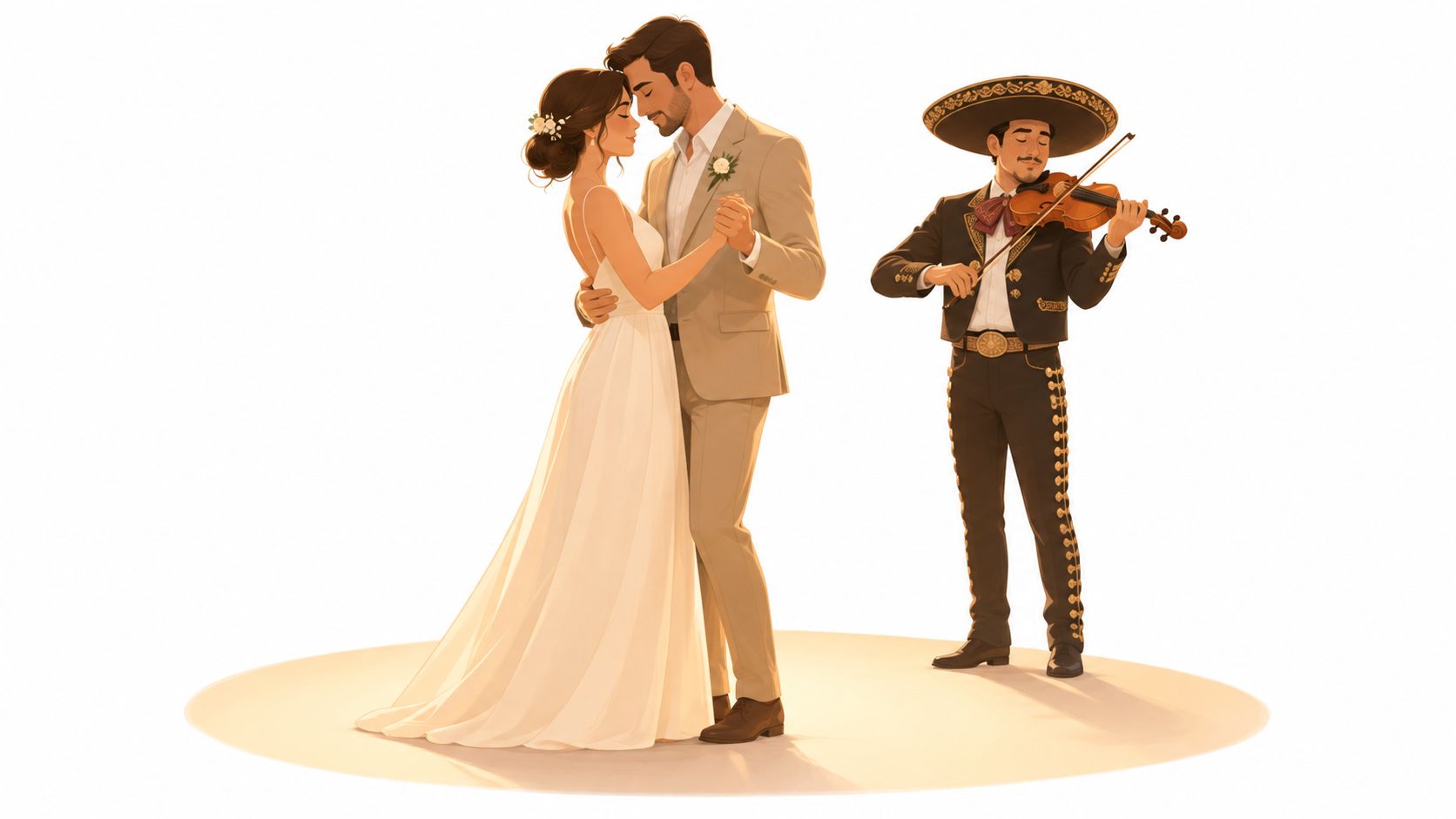
The dance floor is ready, guests take out their phones, and any coordination doubts become visible in seconds. That's why the first dance deserves its own plan. It's not enough to choose a pretty song. You need to decide who will play it, how long it will last, and how it will fit into the real flow of the civil wedding.
The best choice is usually a song that holds significance for the couple and an arrangement designed for dancing, not just listening. In mariachi, this works well when the violin carries the melody, the harmony remains contained, and the volume starts low. If you prefer a small ensemble or voice with guitar, the criteria are the same: stable tempo, short introduction, and clear ending. Many recorded versions are very moving, but live they lose form if they change tempo too much or if the singer indulges too much.
What You Should Finalize Beforehand
Finalize four things in advance: version, tone, duration, and start signal.
If the arrangement is customized, the group needs real rehearsal. They also need a concrete reference. It's helpful to send the original recording and clarify which part you want to keep. Sometimes the couple wants the lyrics, but not the introduction. Or they want the chorus once, not twice. That level of detail prevents a first dance that starts late or lasts longer than comfortable.
Requesting a prior sample helps a lot, even if it's a rehearsal audio. Studio quality isn't necessary. It's necessary to check if the group understood the intention. A romantic ballad can sound intimate or solemn depending on phrasing, tone, and instrumentation.
It's also advisable to resolve a practical point that's often left for last: whether you'll dance the entire song or an edited version. A cut of one and a half to two and a half minutes usually works better than a long version with several verses, especially if you then want to open the floor with family or go straight to the party. The trade-off is simple. The full version respects the original song but requires more confidence on the dance floor. The edited version keeps the moment concentrated and reduces awkward silences.
Coordination between musicians, DJ, and wedding planner matters more here than in almost any other section. Someone must give the exact entrance signal. Someone must know if the couple is introduced first or if the music starts as soon as they reach the center. And if there will be a change from a live version to a recorded track, that transition should be tested beforehand.
To compare profiles that already have videos playing first dances, Mariiachi.com serves as a preliminary filter. It allows you to review repertoires, reviews, and reference prices before contacting directly. What's useful in this section is not seeing who plays louder or more spectacularly, but who maintains tempo, controls volume, and resolves customized arrangements without losing naturalness.
5. Classical Guitar for Formal Reception
The scene is very specific: the signing ends, the couple's exit is over, guests settle in to eat or toast, and the atmosphere calls for music that accompanies without pushing. Here, classical guitar usually works better than larger formats. It fills the space, organizes the awkward silence, and allows conversation to continue.
In small or medium civil weddings, this format resolves well in restaurants, terraces, patios, and low-ceilinged rooms. It also simplifies operation. It requires little setup, almost always takes up less space, and allows for quick volume adjustment if speeches begin or if the banquet service needs to give instructions.
It's advisable to request a repertoire designed for reception, not a technical recital. I usually see better results with a short and clear mix: boleros adapted for solo guitar, traditional Mexican pieces, some Spanish repertoire, and discreet versions of well-known songs. The goal is not to capture all the attention, but to maintain the formal tone of the section between the meal, toasts, and table photos.
There is a real limit. A single guitar may fall short if the family speaks loudly, if the venue is open and windy, or if they expect a more social energy from the first minute of the gathering. In those cases, it's worth asking if the guitarist works with light audio reinforcement or if it's better to switch to a duo with violin, second guitar, or very measured voice.
To hire well, focus less on promises and more on concrete evidence. It's helpful to watch full videos, not just 20-second clips, to check if they maintain pulse, cleanliness, and even volume throughout entire pieces. Mariiachi.com helps as a preliminary filter to compare profiles, reviews, repertoires, and reference prices before contacting directly. In this part of the wedding journey, it saves time because it clarifies who is used to playing during formal reception and who comes more from a serenade or party format.
Three decisions avoid problems that day:
- Define how many blocks they will play and how long each will be.
- Agree on what happens during toasts, speeches, and meal service.
- Confirm if they will bring their own amplification or play completely acoustically.
Well-chosen, classical guitar provides continuity between the ceremony and what follows. It maintains elegance without making the reception rigid. That balance is exactly what many civil weddings need at this part of the day.
6. Themed Banda Playlist for Recorded Party
The scene is very common in a civil wedding. Dinner ends, someone asks to turn up the music, and the couple discovers that a "to set the mood" list isn't enough to open the dance floor or sustain two hours of partying. If you're going to use recorded banda, it's worth treating it as a real part of the music plan, not as last-minute filler.
This option works well when you've already allocated the budget to other sections of the journey, such as the entrance, signing, cocktail, or a first dance with musicians. The savings exist, but they come with a clear trade-off. You lower the cost of operation and setup, but you also lose the ability of a live group to extend a chorus, change the tempo, or respond to the family's mood at that moment.
What yields the best results is preparing it by scenes, not by loose preferences. During the after-dinner, the banda can start with well-known but still comfortable themes for conversation. Then a transition block is advisable, with songs that people recognize quickly and that allow for a smooth transition from table to dance floor. The strong block should be reserved for when there's already a group dancing. If you play the most explosive themes too soon, the curve falls before its time.
A practical detail makes a big difference. Someone should be in charge of the audio. A full DJ isn't necessary, but someone who knows how to cut, move, and adjust volume according to speeches, toasts, photos, or kitchen delays is.
It's helpful to prepare three separate folders or lists:
- one for after-dinner and social start
- another for dance floor opening
- another for party peak and closing
It's also advisable to have a backup downloaded on two devices and confirm with the venue how the audio will be connected. Many failures don't come from the repertoire, but from a missing adapter, an occupied console, or poorly calibrated volume.
To choose songs, focus less on "trendy hits" and more on the real response of your guests. A civil wedding with families of different ages usually works better with well-known banda, easy choruses, and gradual energy changes. If you need ideas to organize that repertoire, a guide like banda repertoire for parties helps to create blocks with more sense. And if you're comparing whether this part is better resolved recorded or with live intervention, Mariiachi.com serves to review profiles, videos, repertoires, reviews, and reference prices before contacting directly.
The recorded playlist works well when it has intention, responsibility, and timing. It works poorly when no one decides what enters, when it enters, and at what volume.
7. Solo Saxophonist for Key Moments
The signing ends, applause begins, and there's that odd minute between protocol and celebration. Here, a solo saxophonist usually works better than a full band or a loose playlist. It gives presence, marks the change of atmosphere, and doesn't require setting up a large format for a ten or fifteen-minute intervention.
It usually performs well in four specific sections of a civil wedding journey: entrance to the reception, toasts, transition to the dining area, and the first block of the cocktail. It can also cover a short first dance if the couple wants a recognizable theme with a warmer tone than the original track. Outside of those moments, it's worth measuring it well. If it plays too long continuously, the resource loses strength and starts to feel repetitive.
Its greatest advantage is practical. It needs little space, setup is usually quick, and the repertoire can move between ballad, bolero, soft pop, and some Latin jazz without changing the entire production. The weak point is also clear. If the musician relies heavily on pre-recorded tracks, the experience improves or falls depending on the quality of the venue's audio and who operates it.
Where It Truly Adds Value
In rooftops, restaurants, terraces, and evening civil weddings, the sax fits very well because it fills without overshadowing conversations. In a very small ceremony, with few people and a sober tone, it can draw more attention than necessary if the performer has a very theatrical style.
That's why it's advisable to hire it by blocks and with clear signals: what song opens, how long each intervention should last, and when it should stop. That detail makes a big difference in the outcome.
The sax works better as a well-placed accent than as background music for an entire hour.
Request two things before closing. First, real event videos, not just studio clips. Second, a short list of useful repertoire for transitions, because toasts run long, photos overlap, and the entrance to the dining area almost never happens exactly on time. If you're comparing profiles, styles, videos, reviews, repertoires, and reference prices before contacting directly, Mariiachi.com serves to better filter which saxophonist fits these key moments and which is designed for a longer show.
8. Hybrid with DJ and Mariachi for a Dynamic Transition
The typical scene is this: the signing ends, hugs are exchanged, someone asks for another photo, the cocktail has already started, and there's still the task of getting people to the dance floor. In this stretch, the hybrid format often works better than a single provider. The mariachi covers the moments with more symbolic weight. The DJ maintains the rhythm for the rest of the event and absorbs delays without leaving awkward gaps.
There's no need to hire live music for five or six hours for the wedding to feel well-accompanied. It's about distributing the roles effectively.
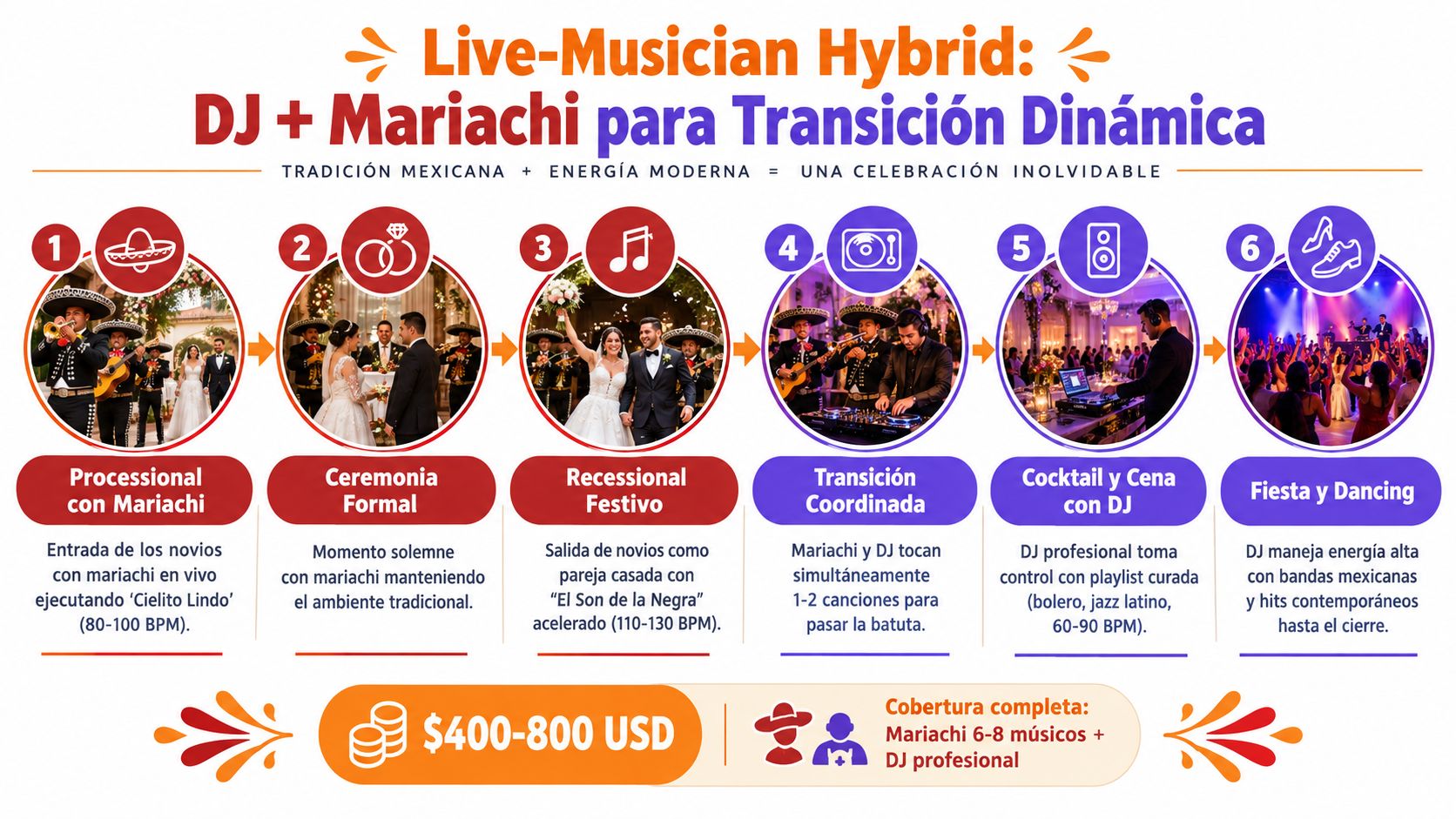
I've seen this format work especially well in civil weddings with a long itinerary: discreet entrance, signing, exit with photos, cocktail, short dinner, first dance, and party. The mariachi steps in where it's best to focus attention. The DJ takes over when the event needs continuity, volume control, and the ability to change plans in seconds. The savings are there, but the real advantage is in the coordination.
The delicate point isn't musical. It's operational. If each provider arrives with their own criteria and no one has marked the transitions, you get cuts, open microphones, sudden volume increases, or a mariachi waiting for a signal while the DJ has already started another track.
It's wise to make four decisions before signing:
- Which moments belong to the mariachi. For example, entrance, ceremony exit, and a short set when the cocktail opens.
- When the DJ starts. Not "after the mariachi," but at a specific time or signal.
- Who controls the overall audio. In small venues, two operators on the same console often cause problems.
- What happens if a segment is delayed. The DJ should have a backup playlist, and the mariachi should know whether to wait, shorten, or change pieces.
A simple distribution often yields good results: mariachi for 20 to 40 minutes of high impact, DJ for cocktail, dinner, recorded first dance if preferred, and the entire party. If you want a more pronounced Mexican identity, you can add a second short mariachi set before opening the dance floor. If the budget is tight, it's better to have a brief but well-placed mariachi than to extend it until it becomes background music.
There are also compromises. The DJ offers flexibility but doesn't replace the visual and emotional presence of live musicians. The mariachi adds character but requires well-timed entrances and exits to avoid stalling the event's flow. Together, they work very well if someone creates a real schedule, not just a song list.
Before hiring, ask for videos of real transitions between both formats, not just isolated clips. Also check how many musicians the mariachi includes, if they bring their own audio, how long they wait on-site, and who coordinates the block change with the DJ. To compare profiles, videos, reviews, repertoires, and reference prices before contacting directly, Mariiachi.com serves as a quite useful initial filter.
Comparison of 8 Musical Options for Civil Weddings
| Option | 🔄 Implementation Complexity | ⚡ Resources Required (approx. cost) | ⭐📊 Expected Results | Ideal Cases | 💡 Key Advantages |
|---|---|---|---|---|---|
| Classic Processional with Mariachi: "Cielito Lindo" and traditional variations | Moderate: requires rehearsal and process coordination | Mariachi 6-8 musicians; optional amplification; $150–400 USD | High emotional connection and cultural presence ⭐⭐⭐⭐ 📊 | Ceremonial entrances for couples who value tradition | Authentic sound and great photographic impact |
| Festive Recessional: "El Son de la Negra" / "Viva Mexico" at energetic tempo | Moderate–high: precise timing as the couple exits | Full mariachi; controlled higher volume; $150–350 USD | Immediate celebratory energy, applause, and good video material ⭐⭐⭐⭐ 📊 | Exits seeking direct transition to the party | Generates festive mood and momentum for the reception |
| Cocktail Hour Instrumental: Bolero and Latin Jazz (live or recorded) | Low–moderate: playlist or 1–2 musicians and audio control | Optional: playlist (0–$15) or 1–2 live musicians $0–300 USD | Sophisticated atmosphere for conversation, elegant yet discreet ⭐⭐⭐ 📊 | Cocktails and appetizers; couples prioritizing conversation | Great flexibility: cheap recorded or intimate live |
| Romantic First Dance: Personalized arrangement with mariachi or band | High: arrangement, rehearsals, and musical coordination | Mariachi/band + personalized arrangement; $300–600 USD | Central and very emotional moment, high interpretative quality ⭐⭐⭐⭐⭐ 📊 | Couples wanting a theatrical and personalized first dance | Deep personalization and high emotional charge |
| Classical Guitar Instrumentals for formal reception | Low: direct hire and predefined setlist | Professional solo guitarist; $150–300 USD | Refined and intimate atmosphere, elegant sound facilitating conversation ⭐⭐⭐ 📊 | Formal dinners and receptions in enclosed spaces | Requires little space; moderate cost; classic aesthetic |
| Themed Soundtrack Playlist (recorded) | Low: curation and organization by phases | Audio system/DJ; streaming $0–15 USD (or DJ) | Long party coverage, high energy for dancing ⭐⭐⭐⭐ 📊 | Couples with tight budgets seeking a massive party | Extremely economical and DJ-controllable |
| Solo Saxophonist for key moments | Low–moderate: requires entry coordination | 1 saxophonist; optional amplification; $100–250 USD | High emotional impact at key moments, versatile ⭐⭐⭐⭐ 📊 | Toasts, dish entries, intimate transitions | Economical, visually appealing, and adaptable |
| Live-Musician Hybrid: DJ + Mariachi (dynamic transition) | High: coordination between DJ and mariachi; joint rehearsals | Mariachi 6-8 + professional DJ; $400–800 USD | Complete event coverage, blend of tradition and modernity ⭐⭐⭐⭐⭐ 📊 | Couples wanting the best of both worlds and a pro experience | Combines ceremony authenticity with DJ control and energy |
Turn Your Selection into a Surprise-Free Music Plan
A good selection of music for civil weddings doesn't come from making a list of pretty songs. It comes from assigning a specific function to each moment. Entrance, signing, exit, cocktail, first dance, toast, dinner, and party. When each segment has intention, the event feels fluid even if it's brief.
Start with something simple. Decide which parts need live music and which can be handled with recorded audio. Don't try to fill every minute. In many civil weddings, fewer well-placed pieces work better than hours of poorly distributed music.
It's also wise to nail down real durations. The entrance almost always takes less time than the couple imagines. The signing can vary. The cocktail needs continuity, but not prominence. The first dance should have a clear exit. And the party needs an energy curve, not just random songs.
Check the venue's acoustics before hiring. A small patio can make a large mariachi overwhelming. An open hall can swallow a guitar without minimal support. A sax can shine in the right transition and be a nuisance if it stays too long. The ideal format depends much more on the space than many providers admit.
Always ask for recent videos, available repertoire, and a clear idea of the setup. If you're hiring musicians, confirm in writing the schedules, breaks, equipment, set changes, power needs, arrival time, and what happens if a part of the program shifts. That document prevents more problems than any last-minute call.
It's worth remembering the real size of the market. In Mexico, the INEGI Marriage Statistics recorded 486,645 marriages in 2024, with a national rate of 5.4 marriages per thousand inhabitants aged 18 and over, after 5.7 in 2022 and 5.6 in 2023, according to this summary on live music and weddings in Mexico. This indicates a broad and fairly stable demand. In practice, it's wise to get quotes in advance and compare options calmly, not when the date is already upon you.
If you need to land providers, Mariiachi.com can serve as a comparison point. There you can find musicians by instrument, genre, and location, review profiles with videos, repertoires, reviews, and reference prices, and then contact the performer or group directly. For a civil wedding, this is very helpful because the challenge is not usually finding "music," but finding the right format for each moment.
In the end, a well-musicalized civil wedding doesn't need to saturate the space. It needs each entrance, signing, exit, and transition to have a clear intention and a clean execution.
If you already know which moments you want to cover, on Mariiachi.com you can search for mariachis, DJs, saxophonists, guitarists, and other formats to compare videos, repertoire, reviews, and reference prices before contacting. It's a practical way to land the music for civil weddings according to your city, budget, and the real style of your event.