
The playlist that accompanies every moment of your wedding starts long before anyone hits the dance floor. It begins when you wonder what will play as you walk in, what music will set the tone during the cocktail hour, and which songs will get your guests moving without disrupting the vibe. This is where many couples get stuck, because searching for Spanish wedding music often leads you to generic lists, not helpful decisions.
The reality is simpler. You don't need a single perfect playlist. You need several mini playlists well-suited for each moment, with a musical format that fits each part of the event. A beautiful song can fall flat if played by the wrong group, at the wrong volume, or at the wrong time.
In Mexico, music already holds a significant place in the wedding budget. A country-focused guide reports that it represents 10.5% of the total wedding cost, and another market aggregate places the average music expenditure at $18,936 MXN, also showing operational ranges like mariachis from $6,000 to $12,000 MXN per hour in CDMX, bands from $25,000 to $60,000 MXN per event, and string quartets from $9,000 to $18,000 MXN (musical budget references for weddings in Mexico).
Here you'll find 10 ideas organized by real wedding moments. For each, I provide reference songs, the best live format to support them, advantages, risks, and a concrete action to coordinate repertoire, timing, volume, and transitions with musicians.
Index
- 1. Romantic Classics for Ceremony
- 2. Reception and Cocktail for a Sophisticated Atmosphere
- 3. First Dance and Couple Songs
- 4. Toast Time with Emotional Ballads and Family Songs
- 5. General Dance with Latin Hits of All Time
- 6. Mexican Regional Music with Banda, Norteño, and Ranchero
- 7. Cuban Salsa and Caribbean Rhythms
- 8. Modern Latin Pop and Soft Reggaeton
- 9. Cumbia and Tropical Music for Celebration
- 10. Romantic Duets and Legendary Love Songs
- Comparison: 10 Musical Styles for Weddings
- Turn the List into Your Wedding's Musical Program
1. Romantic Classics for Ceremony
The scene is this: the entrance begins, someone steps forward, the officiant pauses longer than expected, and the music must sustain the moment without intruding. That's why the ceremony isn't built with random "pretty songs." It's structured in segments, with pieces that can handle silences, tempo changes, and a truly contained volume.
If you want a Spanish ceremony with a classic tone, stick to soft ballads, boleros, and recognizable solemn arrangements. "Boda Blanca," "La Marcha de Zacatecas" in orchestral version, "El Amor Colora" for the bride's entrance, and "Amanecer" for the exit can serve as starting points. The rule is simple. If a song only moves you because of the lyrics, it loses strength in a ceremony.
What Format Really Works
For guest and procession entrance, a string quartet is usually the safest bet. It sets the mood, sounds elegant, and doesn't intrude. If the wedding seeks something warmer and more intimate, a guitar and violin duo works better in small spaces or outdoor ceremonies.
Live vocals are only advisable at very specific moments, like the main entrance or a special signing. Having a singer throughout the ceremony increases the risk of volume mismatches, misplaced breaths, or distracting lyrics. Here, the format that accompanies wins, not the one that tries to steal the scene.
Organize the music into three clear blocks:
- Guest Entrance: soft and stable pieces, without abrupt changes.
- Processional and Central Moments: more solemn themes, with clean starts and easy-to-cut or extend endings.
- Exit: a bright, more open piece with a sense of forward movement.
This order avoids one of the most common mistakes: using the most intense song too early and leaving no closure for the exit.
It's also wise to set concrete criteria with the group. Request a main version and a backup for each important moment. Define how much they can extend an entrance if the procession is delayed. Clarify the maximum volume before the ceremony begins. And send a brief list with three categories: must-haves, optional, and prohibited.
If you want to coordinate repertoire, timing, volume, and transitions without improvising on the wedding day, check out the wedding music hiring guides from Mariiachi. They help you request what's right for the moment and format, not just based on the song.
2. Reception and Cocktail for a Sophisticated Atmosphere
The guests have just left the ceremony, they ask for a drink, look for family, and the first conversations begin. At this moment, the music has a clear task: to be present without overshadowing the room.

For this time slot, clean arrangements, medium tempos, and recognizable repertoire without drama work well. Light boleros, acoustic Latin pop, piano with discreet percussion, saxophone over soft bases, and bossa with known songs work very well. "Perfume de Gardenias" with a jazz twist, "Qué locura enamorarme de ti" in bossa style, or "Cuando vuelvas a mi lado" in an intimate version perform better than a too intense interpretation.
Here, it's important to match style with format. If the cocktail is short and the space is elegant, a voice and guitar or piano duo solves almost everything. If there's a terrace, constant movement, and scattered tables, an acoustic trio gives more body without raising the volume. Sax with a soft base works well in hotels and large halls. A restrained DJ is more useful when transitions between cocktail, dinner call, and dinner entry need to be very measured.
The typical mistake is to bring out the strong part of the party too early. Bringing in a full mariachi, band, or a too prominent vocal set at the reception breaks the conversation and tires quickly. That format can work later, when the wedding already calls for energy. Not here.
Order the block in three segments so the atmosphere grows without jumps:
- Arrival at the Cocktail: warm, known themes with little attack.
- Social Peak: slightly more rhythmic songs, but still comfortable for conversation.
- Call to Dinner or Next Moment: clearer closure, with endings easy to link or cut.
It's also wise to leave precise instructions with the group or DJ. Define a real top volume. If someone has to raise their voice to speak, it's already too loud. Request repertoire by categories: recognizable classics, neutral themes, and prohibited songs. And specify who gives the signal to change blocks, because a poorly finished cocktail often delays everything that follows.
A practical recommendation: don't create a playlist based solely on personal taste. Cross guest age, cocktail duration, and contracted format. An elegant bolero with a live duo might be perfect for an intimate wedding and completely lost in a large reception with service noise and a lot of circulation. There, a format with more presence wins, not more volume.
3. First Dance and Couple Songs
The first dance begins, the intro plays, and within ten seconds you can tell if they chose well. If the song forces you to count steps, wait for odd changes, or fight with the tempo, the moment loses naturalness and cools down.
Here, a simple rule prevails: movement first, symbolism second. The best song for you doesn't always work for dancing in front of everyone. If it has abrupt pauses, theatrical rises, or a too intense lyric, save it for the video, dinner, or a special entrance.
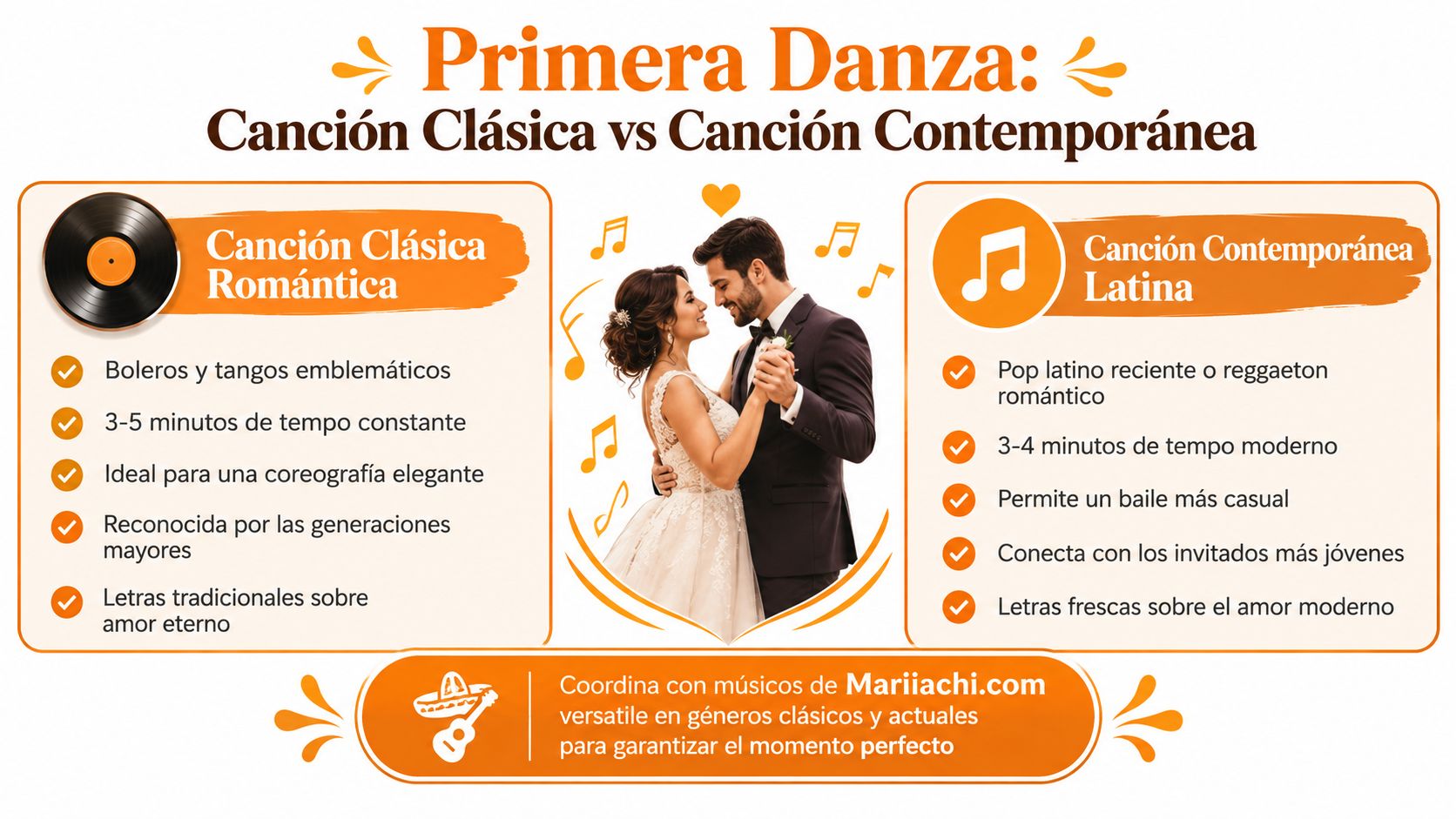
For the first dance, choose songs with a clear pulse, long phrases, and an ending easy to cut or extend. A soft bolero, a clean pop ballad, or a well-supported acoustic version works better than a beautiful but unstable song live. If the format will be live, a voice and guitar duo gives intimacy in small weddings. In large halls, piano with voice or a small ensemble supports the space better without forcing the volume up too much.
Do a real test at home. Walk the entire song, enter together, mark a turn, a hug, a short spin, and an exit. If after a minute you're thinking more about surviving than enjoying, change the song.
If a song moves you more than it supports your body, it's not right for the first dance.
It's also wise to separate each couple moment by function. The first dance requires stability. The entrance song can accept more impact. The dinner background allows more personal lyrics. This division avoids using your favorite song in the wrong place.
For the dance with mom, dad, or a family member, change the criteria. Here, immediate recognition and comfort in movement win. Choose a direct song, with a noble lyric and contained duration. Avoid ambiguous or too romantic themes, as they create discomfort even if they are musically beautiful.
If you're hiring musicians, check options in the search for groups for first dance and romantic ballads and ask them for three specific things: an exact or very close version to the original, a clear signal to start and end, and moderate volume throughout the block. Also, define if you want a full performance, a shortened version, or an entrance with singing afterward. This detail saves missteps and greatly improves transitions with photo, video, and dance floor opening.
4. Toast Time with Emotional Ballads and Family Songs
The champagne is opened, someone asks for the microphone, and an aunt is already pulling out the handkerchief. At this point, the music has one task: to sustain the moment without intruding.
Here, it's wise to work in layers. Before the first toast, use background or very light ballads at low volume. During speeches, real silence. When closing, enter with a short and recognizable song that embraces the applause and marks the shift to a looser part of the reception.
"Gracias a la vida" can work if the family has a clear bond with that song. "Costumbres" too, but only if you want a more nostalgic tone and know it won't sink the mood. In many weddings, a warm, close, and easily recognizable piece works better than a too intense interpretation.
Make this choice based on the musical format, not just the song.
If the toast will be brief and in a medium-sized hall, a soloist with guitar or keyboard handles the entrance and exit very well. If several family members will speak, the DJ or audio operator usually provides more control because they can cut and relaunch precisely. For very participative families, a sober duo works better than a large group. It gives presence without stealing focus.
What you should lock down in advance:
- Who gives the exact signal to lower and raise music.
- What song enters after the last speech ends.
- How long that musical exit should last.
- What maximum volume is allowed while toasts, photos, and videos circulate.
At Mariiachi.com, request this block as a separate moment from the cocktail and dinner. This way, you can coordinate repertoire, pauses, and transitions without mixing criteria. It also avoids a common mistake: leaving the musician improvising filler while someone looks for the next speaker.
A final filter. If the lyrics sound like farewell, loss, or suffering, remove it from here even if it's beautiful. The toast calls for shared emotion, not tears that are hard to recover from.
5. General Dance with Latin Hits of All Time
The dance floor opens, two aunts go first, then a couple of friends, and within three songs you know if the party has started or if it's stuck halfway. Here, one thing rules: read the room and manage the energy wisely.
The general dance block works better in layers. Start with very recognizable Latin songs, with a friendly tempo and easy chorus. Then move to songs that truly get multiple generations on the floor. Save the most intense tracks for when there's already a group dancing and no one is hesitating to join.
A useful mix might cross salsa, cumbia, merengue, Latin pop, and one or two singable classics. "Bésame Mucho" works if you want to link a romantic segment with the dance floor. "Vivir Mi Vida" or "Bailando" perform better when the room has already responded. "El Son de la Negra" is a big hit, but it's best used as an energy boost, not as a start if there are still people seated.
What Format Works for This Moment
If your priority is total control of timing, quick changes, and immediate audience reading, the DJ handles this block better. If your family dances and sings, a small orchestra or tropical group lifts the floor with more presence. If you want to mix generations without abrupt cuts, combining live music for the first segment and a DJ to sustain the late night usually yields better results than betting everything on a single format.
Don't choose just by musical taste. Choose by the real response of the audience.
Rules Worth Locking Down
- Start with 3 to 5 easy-entry songs, not with the peak of the night.
- Define 2 wildcard songs to rescue a lull on the floor.
- Submit a written list of banned songs. Include harsh heartbreak, lyrics uncomfortable for the family, and songs linked to ex-partners.
- Set a volume cap for the start. If you start too high, you drive away older guests and cut off table conversations that are still joining.
- Request clear transitions between styles. Jumping from ballad to reggaeton or from salsa to regional without a bridge often empties the floor.
If you coordinate it with Mariiachi.com, request this block as a separate moment within the musical program. This way, you can set duration, format, base repertoire, room for improvisation, and the signal to switch to regional, tropical, or urban pop without leaving the floor to chance.
The typical mistake here is trying to fit all tastes into fifteen minutes. That splits the night. Better to create a sequence that gradually adds people, sustains those already dancing, and leaves room to change styles without breaking the atmosphere.
6. Mexican Regional Music with Banda, Norteño, and Ranchero
"El Rey" plays and half the family stands up on their own. You don't get that reaction with just any style. Mexican regional works when you treat it as an intentional moment within the wedding, not as filler between blocks.
Here, context rules. Mariachi, banda, and norteño don't serve the same function, even if they share an audience. Mariachi works best in emotionally significant moments. Banda calls for a party already in full swing and space to ramp up energy. Norteño fits well when you want tables singing, couples dancing close, and a less ceremonial atmosphere.
Mariachi carries a strong tradition within Mexican weddings and remains a safe bet for entrances, surprises for the couple, family toasts, or a closing where everyone sings. If you play it during dinner at too high a volume, it kills conversation. If you reserve it for a highlighted moment, it gains presence without intruding.
A practical way to organize it is this:
- Mariachi: couple's entrance, greeting to parents, toast, surprise serenade, sentimental closing.
- Norteño: intermediate block to boost mood without making the floor chaotic.
- Banda: high point of the party, when you no longer need to convince anyone to dance.
The repertoire also needs filtering. "El Son de la Negra" and "La Bikina" work for opening or marking presence. "Cien Años" and "Volver, Volver" hit better in collective singing or nostalgic moments. "El Rey" lifts easily, but use it where the tone already allows for release and chorus. Playing intense songs too early can overload the atmosphere.
If your wedding mixes generations, this block is best in short or medium duration. Twenty to thirty well-chosen minutes usually yield more than a full hour of regional. This way, you capture the emotional peak without leaving out those who prefer salsa, pop, or tropical.
Request clear transitions. From romantic ballad to banda sinaloense without warning, the jump feels abrupt. From norteño to cumbia, however, the transition is usually smoother. Also, lock down who decides live requests, how much room there is for improvisation, and which songs are banned due to lyrics, family history, or simple fatigue.
If you coordinate it with Mariiachi.com, use it to bring this down to real operation: what format goes in each moment, how long the block lasts, what volume the venue can handle, and with which exact song it starts and ends. That's where this style stops being a loose idea and becomes a well-tied part of the musical program.
7. Cuban Salsa and Caribbean Rhythms
The first strong dance block plays, several tables have already left their seats, and you want to raise the temperature without turning the dance floor into a dance exam. That's where salsa comes in, but well placed. If you bring it in too early or too technically, part of the audience will step back. If you fit it in at the right moment, it lights up the party and truly flavors the wedding.
Here, context rules. Cuban salsa and Caribbean rhythms work best when the floor has already responded to easy-to-follow songs and the group has lost their shyness. They also require the right format. A DJ handles transitions between salsa, son, merengue, and light timba well. A small orchestra or live group gains presence if you want a block with more show, brass, and real percussion. For mixed-age and taste weddings, a short or medium block is advisable, not a full hour.
How to Include This Block Without Emptying the Dance Floor
Start with the most recognizable and leave the most demanding for later. "Vivir mi Vida" and "La Vida es un Carnaval" enter easily. Then you can ramp up with "Llorarás," a tasty son, or a cha cha chá that keeps people dancing without forcing them.
Order matters a lot. Use a clear rise sequence: singable salsa, salsa with more drive, Caribbean breather, return to the hit. That breather can be a well-known merengue or an easy-chorus tropical. It helps the floor not split between those who dance well and those who just want to follow the rhythm.
If the couple, close friends, or part of the family really dance salsa, give prominence to the live format. There, an orchestra, a tropical ensemble, or a lineup with strong percussion shines more. If the audience is varied and not particularly into salsa, the DJ is usually a better option because it allows for cutting, mixing, and quickly returning to universal songs.
There's also a clear risk. Long and very specialized salsa turns the rest into spectators. At a wedding, that weighs heavily. Better a mini selection with intention than an eternal block that only the good dancers' table admires.
Ask Mariiachi.com for concrete decisions, not general ones: how long the block lasts, which song starts it, at what point it switches to merengue or tropical, what volume the venue can handle, and which songs are excluded due to lyrics, intensity, or lack of familiarity. This way, this style doesn't remain a musical whim. It's integrated into the real program of the party.
8. Modern Latin Pop and Soft Reggaeton
After dinner and toasts, the dance floor starts to call for a change. That's the moment to introduce modern Latin pop and soft reggaeton. Not before. If you play it too early, you break the wedding vibe and alienate half the family.
This is where filtering is key. Choose clean tracks, choruses everyone knows, and beats with a clear rhythm, but without overly aggressive or sexualized lyrics. At weddings, friendly reggaeton, melodic urban pop, and songs that allow for singing, not just dancing, work best.
Where It Works Best and in What Format
This block works best in the middle or upper-middle part of the party, when people are comfortable and open to a more current twist. It helps rejuvenate the dance floor without dedicating the entire night to one style.
The best format is almost always a DJ. They can edit long intros, clean up versions, shorten songs, and quickly transition to Latin pop, Spanish dance, or well-known hits from another decade. A live format is only advisable if the band masters modern arrangements with a good rhythmic base and knows how to control the volume. Otherwise, the result feels forced or too heavy for this repertoire.
Don't make it an endless block.
Create a short, clear, and well-placed set. Five to eight songs are usually enough to give a modern touch without tiring guests who prefer singing, dancing in pairs, or following more familiar rhythms.
What You Should Request
Request songs with these characteristics:
- lyrics suitable for a mixed audience
- a chorus recognizable in seconds
- consistent rhythm, without long breaks
- edited duration if the track is too long
- easy transition to cumbia, Latin pop, or tropical
Also, consider the message. There are very popular songs that talk about jealousy, infidelity, heartbreak, or casual encounters with a rawness that clashes at a wedding. If you like the beat, change the version or drop the song.
Mariiachi.com helps more if you give specific instructions: when this block should start, how long it should last, what volume level the venue accepts, which songs are banned due to lyrics, and with which song it should end to return to a broader dance floor. This way, urban pop adds energy without taking over the party.
9. Cumbia and Tropical Music for Celebration
It's 11:30. The first wave of euphoria has passed, part of the family is still seated, and the dance floor needs to bring them back together. That's where cumbia comes in. Not as filler. To reconnect guests who don't dance the same way but do respond to a clear and familiar rhythm.
Here, it's wise to think by moment and format, not just by taste. If you want to open the dance floor confidently, use classic cumbia and soft tropical live with a versatile band or well-measured sound system. If you need to bring people back after a heavier block, the DJ works better because they can shorten intros, quickly raise the beat, and transition from one singable cumbia to another without long pauses.
The advantage is obvious. Cumbia invites without requiring technique, accommodates mixed ages, and holds up well for a celebration set. The risk is also clear. If the band plays everything with the same beat, the dance floor flattens in ten minutes. And if you play too much tropical music in a row, the wedding starts to feel monotonous.
Organize this block with intention:
- Dance Floor Entry: very recognizable cumbias, medium tempo, and immediate chorus.
- Block Center: mix a romantic tropical, a more festive one, and a collective singing song.
- Finish: pick it up a bit with light merengue or a more energetic cumbia, but exit before it wears out.
For family weddings, a set of 15 to 25 minutes usually works better than an eternal half-hour. In young weddings, use it as a bridge between Latin pop, light salsa, and party hits. In weddings with many older guests, give it more space, but control the volume. People dance more when they can talk between songs without shouting.
If you hire live music, request something very specific: which cumbias you want, which you don't, how long the set should last, and with which song it should close to connect with the next moment. Mariiachi.com is useful right there because it allows you to coordinate repertoire, timing, volume, and transitions in advance, instead of improvising in the middle of the venue. This way, cumbia fulfills its real function. To unite the party and bring back movement without taking over the entire night.
10. Romantic Duets and Legendary Love Songs
The scene works like this. The party is underway, the dance floor has responded, and now it's time to lower the intensity a notch without emptying the venue. That's where duets and legendary love songs come in. They serve to refocus the wedding on the couple and to provide an elegant breather before ramping up again.
This block works best at night and in short sets. Between 10 and 15 minutes is usually enough. If you stretch it too long, you slow down the energy. If you introduce it too early, it feels heavy.
“Bésame Mucho” and “La Quiero a Morir” work because the audience recognizes them and they don't require a full dance floor to sustain the moment. Songs with a conversational structure, shared chorus, or two-voice interpretation also help, even if they're not literal duets. In a live format, a vocal duet, trio, or soloist with good control of nuances wins here. A large band is often unnecessary in this segment, and a DJ without fine editing can disrupt the mood with abrupt transitions.
When to Play Them and How to Avoid Excessive Sappiness
Play this block after a strong dance set or before the romantic close of the night. It works especially well if you want to make room for hugs, photos on the dance floor, and couples dancing without everything becoming slow.
The selection criteria should be simple. Clear lyrics, recognizable melodies, and sober arrangements. Avoid chaining three dense ballads in a row or overly dramatic songs if the wedding has a cheerful and familiar tone. One intense piece can move people. Four in a row tire them out.
It's also wise to clearly separate intention and repertoire. There are classics that everyone respects, but not all serve the same moment. “Amor Eterno,” for example, can touch very deep emotions and fits better in a tribute or family toast than in a romantic couple's block. On the other hand, “Bésame Mucho” or “La Quiero a Morir” better sustain an intimate moment without changing the overall mood of the wedding.
Don't assume the band plays any classic. Request the exact song in writing, the version, the key if it matters, the approximate duration, and when it should start. If you book the block through Mariiachi.com, use it to finalize repertoire, volume, and transition with the next set. That level of detail avoids awkward silences and also prevents a romantic moment from sounding generic.
Comparison: 10 Musical Styles for Weddings
| Option | Complexity (🔄) | Necessary Resources (⚡) | Results / Quality (📊 ⭐) | Ideal Use Cases (💡) | Key Advantages (⭐) |
|---|---|---|---|---|---|
| Romantic Classics for Ceremony | 🔄🔄 | Instrumentalists (violin, organ, guitar), arrangements and rehearsals | Solemn and emotional atmosphere; high musical quality ⭐⭐⭐⭐ | Bride and groom entry/exit, vow exchange | Recognizable across generations; adaptable to live formations |
| Reception and Cocktail: Sophisticated Atmosphere | 🔄🔄 | Trio or lounge DJ, volume control, long playlist | Conversational and refined atmosphere; moderate intensity ⭐⭐⭐ | Cocktail hour, initial reception | Facilitates socialization; smooth transition to party |
| First Dance and Couple's Songs | 🔄🔄🔄 | Live musician or instrumental track; prior rehearsal | Emotional and photographic connection; very evocative ⭐⭐⭐⭐ | First dance, father-child dance, dedications | Highly customizable; designed for intimate moments |
| Toast Hour: Emotional Ballads | 🔄🔄 | Singer or instrumental, coordination with speeches | Reflective and memorable moment; emotional impact ⭐⭐⭐ | Toasts, parent speeches, and tributes | Strengthens family bonds; ideal for emotional video and photos |
| General Dance: Timeless Latin Hits | 🔄🔄🔄 | Experienced DJ or versatile band, robust PA system | High dance floor participation; sustained energy ⭐⭐⭐⭐ | Main party, dance night | Keeps dance floor full; broad generational appeal |
| Mexican Regional Music: Banda/Norteño/Ranchero | 🔄🔄🔄 | Traditional band (multiple musicians), space and volume control | Cultural authenticity and intense party ⭐⭐⭐⭐ | Traditional Mexican weddings, family events | Connects with roots; creates genuine festive atmosphere |
| Cuban Salsa and Caribbean Rhythms | 🔄🔄🔄 | Salsa band or specialized DJ, percussion and wide dance floor | Tropical and very danceable atmosphere; contagious ⭐⭐⭐⭐ | Weddings with Caribbean heritage, dance showcases | Generates high energy; suitable for dance demonstrations |
| Modern Latin Pop and Soft Reggaeton | 🔄🔄 | Modern DJ, updated playlists (radio edit) | Contemporary and relevant atmosphere; accessible ⭐⭐⭐ | Young couples, generational mix | Current and easy to play; connects with young audience |
| Cumbia and Tropical Music for Celebration | 🔄🔄 | Regional band/percussion, knowledge of specific rhythms | Inclusive and joyful atmosphere; sustained participation ⭐⭐⭐ | Latin American celebrations, family dance floors | Intergenerational appeal; easy-to-follow rhythm |
| Romantic Duets and Legendary Love Songs | 🔄🔄 | Vocal duo or high-quality tracks, good sound system | Intimate and emotional moments; important vocal quality ⭐⭐⭐ | Dedication sections, intimate moments at night | Represents the couple; emotional and direct in meaning |
Turn the List into Your Wedding Music Program
The most useful way to use these ideas is not to copy songs one by one. It's to turn them into a program. First, divide your wedding into five real blocks: ceremony, cocktail, toast, first dance, and party. Then assign each block a clear objective. Emotion, conversation, tribute, intimacy, or energy.
Next, mark three things in writing: must-have songs, banned songs, and optional songs. This simple filter avoids bad improvisations. It also helps you communicate better with the mariachi, DJ, band, or trio, because you're no longer saying "something romantic" or "something cheerful." You're telling them exactly what moment you want to create.
The next step is to choose the format, not just the repertoire. For the ceremony, strings, guitar, piano, or a well-measured mariachi usually win. For the cocktail, an acoustic duet or elegant DJ. For the dance floor, band, DJ, regional, or a combination. If your family is diverse in ages, mix it up. If your wedding has a very clear musical identity, tighten the concept more, but don't forget who you'll have in front of you.
Fine coordination matters as much as song selection. Confirm entry times, first dance duration, pauses for speeches, volume per block, space for setup, planner contacts, and a plan B if a song doesn't work, if a speech runs long, or if the weather changes. In live formats, also confirm which pieces require rehearsal and which are already part of the group's regular repertoire.
In Mexico, the wedding market has been described in industry materials as around $7.5 billion annually with about 486,000 weddings per year, a scale that helps understand why music holds such a visible place in many couples' planning (dimension of the wedding and live music market in Mexico). With such a variety of styles, budgets, and formats, comparing before hiring is no longer a luxury but a practical necessity.
If you're already at the stage of finalizing options, it's worth reviewing profiles with videos, repertoire, reference prices, and verified reviews to decide with more context. Mariiachi.com can help you make that comparison and contact directly the musician or group that fits the type of wedding you're planning.
If you already have your songs clear, the next step is to find who can play them well and at the right moment. At Mariiachi.com you can search for mariachis, bands, DJs, and musicians by genre, location, and instrument, compare profiles with videos, reference prices, and reviews, and talk directly with the option that best fits your wedding.